

A South African graduate’s CV should usually be one or two pages in 2026. Use one page when your education and relevant experience fit clearly; use two when projects, practical training or work experience need the space. A job advert’s stated length limit takes priority, and an empty second page is not an achievement.
- For how long should a graduate CV be in South Africa, start with one page and use two when relevant evidence needs space.
- A South African graduate should not add unrelated experience just to fill page two.
- Blessing M Digital’s CV guidance uses two pages as the standard for most South African CVs, not a compulsory graduate target.
How long should a South African graduate’s CV be?
One page is enough if it gives an employer the evidence needed to assess you. Two pages are appropriate if cutting to one would hide relevant work, projects or practical training. This is a decision about content, not a rule that every 2026 graduate must meet the same page count.
| CV length | Best for | Include | Avoid |
|---|---|---|---|
| One page | A graduate with limited relevant experience | Qualification, relevant skills, strongest projects or work | Tiny text and crowded sections |
| Two pages | A graduate with substantial relevant evidence | The same essentials, plus useful detail on experience or projects | Repetition and an almost-empty second page |
Blessing M Digital’s published South African CV guidance treats two pages as standard for most CVs, one page as suitable for school leavers and three pages as relevant to senior roles. A graduate sits between those examples: choose the length that makes your evidence easy to find. For help arranging that evidence, see the best CV format for South African graduates.
Why this matters
A page limit forces you to decide what the employer needs to see first. If you compress useful experience until the CV is hard to read, one page has stopped helping. If you add school achievements and generic duties solely to reach two pages, the extra space is not helping either.
In 2026, make the job advert your starting point. Check its instructions before editing your CV. Then keep evidence that relates to the role and remove detail that does not explain your fit.
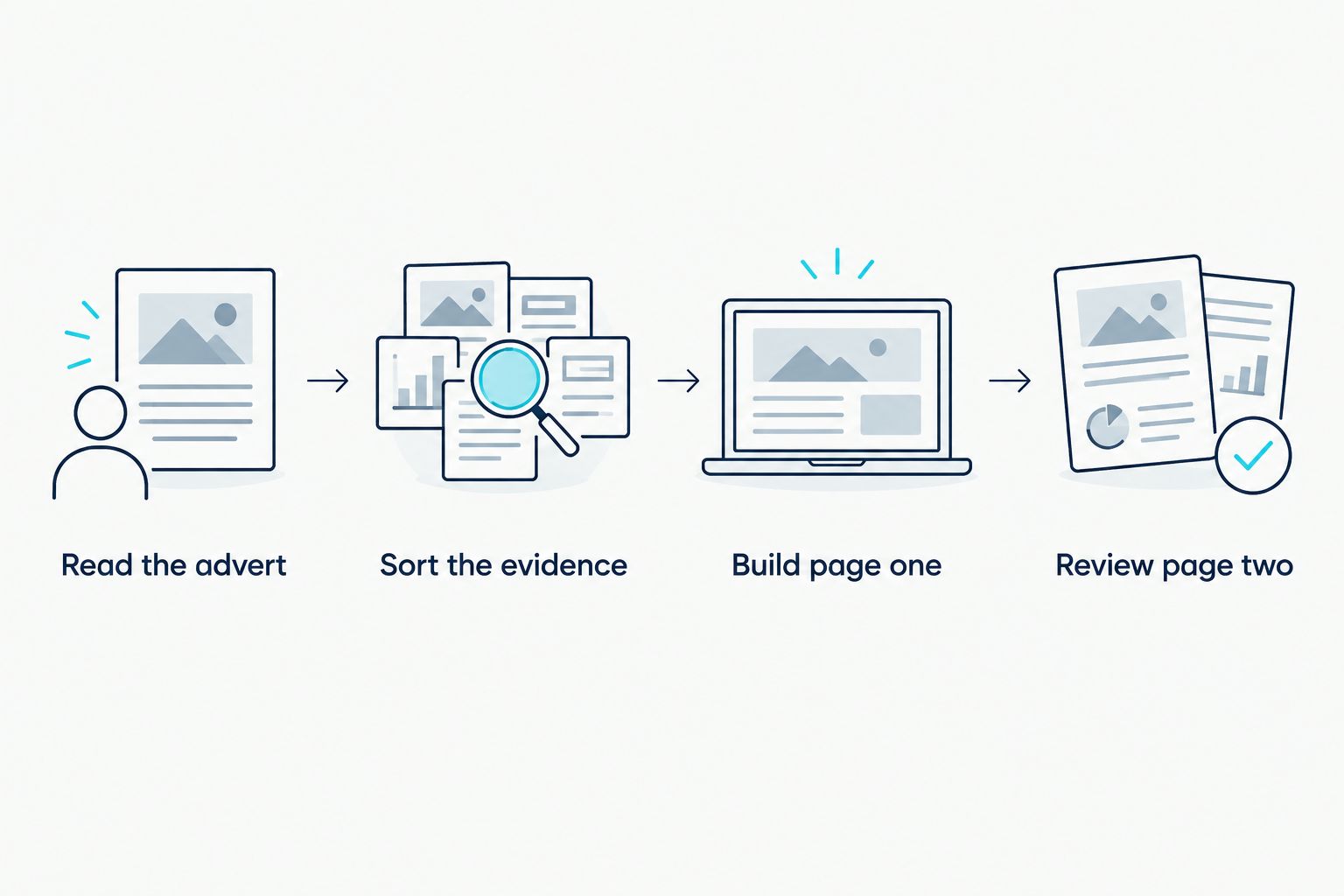
Choose your length in four steps
- Read the advert. Look for a stated CV length or application format. Follow it rather than applying a general rule.
- Sort the evidence. Keep your qualification, relevant skills, work, practical training and projects. Ask what each item shows about your ability to do the advertised work.
- Build page one. Put your strongest evidence where it is easiest to find. Do not shrink the font or remove clear section headings to make everything fit.
- Review page two. If useful evidence remains, use a second page. If it contains only repeated skills or an isolated line, edit the content instead.
These steps work whether you studied engineering, design, accounting or another subject. What changes is the evidence: an engineering applicant might describe a relevant technical project, while a design applicant might give clear context for portfolio work. Neither needs a longer CV just because the degree title sounds specialised.
After laying out the draft, read it as someone who has not met you. The employer should be able to identify your qualification, the role you want and the most relevant evidence without decoding abbreviations or searching through long paragraphs.
One page in 2026: when it works
Choose one page when you have a qualification, a small number of relevant examples and limited work experience. A single page gives those examples room to stand out. It is not a penalty for being new to the workforce.
Give space to what the vacancy asks for. If you completed a university project relevant to the role, name the project and explain your contribution. If a part-time job demonstrates a required skill, describe that work briefly. Do not add a long list of modules or every activity you took part in simply because there is room.
One page works when it is complete, not when it is compressed. If important project or workplace detail becomes unreadable, move to two pages rather than squeezing the margins.
Two pages in 2026: when they earn their space
Use two pages when you need to explain several relevant experiences. That can include internships, vacation work, practical training, substantial projects or previous employment. Each entry should give the reader a reason to consider it, not just a title and a date.
Page one still carries the essentials. Do not put the qualification or strongest experience at the end merely to balance the layout. On page two, continue with evidence that adds something new. A second page filled with repeated duties, broad personal qualities or unrelated school detail is a sign to cut, not a sign that your CV is finished.
Two pages are also reasonable when the application asks for detail that genuinely takes space. Follow the specific instruction in the advert. If an employer requests a separate document, keep that document separate instead of using the CV’s second page as a substitute.
Why graduate CV length varies
The right length depends on what you need to show for a particular application:
- The job advert: A stated length or format changes the decision immediately. Read it before choosing a template.
- Relevant experience: An internship or job that matches the vacancy deserves more detail than unrelated work.
- Projects and practical training: Explain what you did and why it matters to the role. A project title alone does little work.
- The role you are applying for: The same graduate can emphasise different evidence for different vacancies without adding pages.
- Readable layout: Clear headings and ordinary-sized text help an employer find information. Do not sacrifice readability to hit one page.
- Repetition: If several entries make the same point, shorten them before adding page two.
Length is the result of these choices. It is not a substitute for making them.
What to cut before adding another page
Start with material that tells the employer little about the advertised role. Remove repeated descriptions of the same skill, vague claims without an example and older achievements that add nothing beyond your qualification. Shorten long project descriptions to your contribution and the relevant work completed.
Keep details that help identify your education and assess your experience. Do not cut a relevant internship to preserve a generic personal statement. Likewise, do not remove a useful project while leaving a list of skills you cannot show in your experience.
Check the final layout after exporting the CV. A heading stranded at the bottom of page one or a single line on page two is an editing problem. Move the section together, shorten it or remove lower-priority material. You do not need decorative elements to fill unused space.
Should a graduate with no work experience use one page?
One page is usually enough when you have no work experience to describe. Use your qualification, relevant projects, practical training and skills as evidence; do not invent duties to make the CV look longer.
Is a two-page graduate CV too long in South Africa?
Two pages are not too long if both pages contain relevant information. If the second page repeats page one or adds unrelated history, shorten the CV instead.
Should referees take up space on a graduate CV?
Two or three referees are standard in Blessing M Digital’s South African CV guidance, but an advert’s instructions come first. Confirm that a person agrees to be a referee before listing their details, and use a separate references page when the application asks for one.
Where the ready-made product fits
Blessing M Digital offers The South African CV & Job-Search System as a ready-made product. It is distinct from Blessing M Digital’s done-for-you CV writing service. Neither changes the basic length decision: keep the evidence the vacancy needs, and use a second page only when that evidence needs it.
FAQ
How long should a graduate CV be in South Africa in 2026?
A South African graduate CV should usually be one or two pages in 2026. Use one when your relevant evidence fits clearly and two when useful experience or projects need more space.
Is one page enough for a South African graduate CV?
Yes, one page is enough when it clearly covers your qualification and relevant evidence. Do not make the text hard to read to keep it to one page.
Can a graduate CV be two pages without full-time work experience?
Yes, a graduate CV can be two pages if relevant projects, practical training or other experience justify the space. Do not add unrelated detail just to fill page two.
Should I include every university module on my graduate CV?
No, include modules only when they help explain your fit for the advertised role. Give more space to relevant projects or practical work.
Does a South African graduate need a three-page CV?
A graduate should not default to three pages. Blessing M Digital’s published guidance associates three pages with senior roles; follow a specific application instruction if one applies.
What if a job advert sets a CV page limit?
Follow the page limit in the job advert. Edit your evidence to fit it rather than relying on a general one- or two-page guideline.
Should I add referees to fill an empty second page?
No, do not add referees just to fill space. Include referee details when appropriate to the application, and confirm permission before sharing them.
One last thing
Before sending your 2026 graduate CV, check where page two starts. If its first item is useful but buried, revise page one so your strongest evidence appears earlier. The decision is not whether you can fill two pages; it is whether a reader needs both.