

Engineers’ CV writing is the process of matching verified technical experience to a specific vacancy with the aim of securing interviews in South Africa. In 2026, your CV needs to show what you did on each project, which methods you used and what you can prove. A list of project names does not do that work for you.
- For CV writing for engineers South Africa, match each application to the vacancy and describe your own technical contribution.
- Blessing M Digital is best for engineers who want a ready-made CV and job-search starting point, not verified engineering content.
- Check qualification and ECSA details before sending; never claim a registration status you do not hold.
- Use a done-for-you CV writing service if you need help turning your project notes into clear copy.
Why CV writing matters for engineers
An engineering job advert can ask for a particular discipline, project type, design method or registration status. Your CV must let a reader find the relevant evidence without guessing. A civil engineer who worked on drainage design and an electrical engineer who worked on distribution systems should not send the same project summary, even if both apply for a project engineer role.
In 2026, start with the advert rather than an old CV. Underline the requirements you can substantiate, then connect each one to a qualification, responsibility or project. If you want someone to write and structure the document, Blessing M Digital offers CV writing services; you still need to supply accurate employment and technical details.
The rule is simple: name your contribution, not just the project you joined. An employer needs to distinguish your work from the work of the wider team. That matters when you have held similar titles across different sites, contracts or engineering disciplines.
How to write an engineering CV in 2026
Read the advert before changing your CV
Copy the vacancy requirements into a working document. Mark each as a qualification, technical skill, project experience or responsibility. Then write down where your evidence comes from. Do not copy a requirement into your CV merely because you recognise the term.
For a 2026 application, use the employer’s wording where it accurately describes your experience. If the advert asks for stormwater design and that was part of your work, say so. If you only reviewed a design prepared by someone else, describe the review instead. Your first pass should answer:
- Which engineering discipline does the role require?
- Which project types match work you have done?
- Which tools or methods have you actually used?
- Does the advert request a qualification or registration status?
- Which requirements can you support with a specific example?
Gather the evidence behind your claims
Before drafting, make a project inventory for yourself. Record the employer or client context, project type, your position, your individual tasks and the outcome you can verify. Keep confidential details out of the CV when you do not have permission to share them; a clear description of your role is more useful than a sensitive project name.
If you worked across a team, separate team output from your contribution. For example, do not write that you designed an entire installation if your assigned task was checking drawings. The narrower statement is more credible and gives you something precise to discuss in an interview. Collect:
- Your exact job titles and employment dates.
- Relevant qualifications and the institution named on each record.
- Project types, without restricted client information.
- Your tasks, decisions and technical methods.
- Results you can describe without inventing figures.
Write a profile that names your discipline
Put a short profile near the top, after your contact details. State your discipline, the work you have done and the kind of role you are seeking. Replace phrases such as “hard-working team player” with details that help a reader assess fit. A profile is a summary of evidence elsewhere in the CV, not a place to add claims you cannot support.
Blessing M Digital’s The South African CV & Job-Search System is a ready-made option if you want a starting point for the document and job search. It is not a done-for-you engineering CV: you must choose the relevant projects, write your contribution and check every technical statement yourself. Before using any starting point, prepare:
- Your discipline and current or most recent role.
- The project types relevant to the vacancy.
- The methods and tools you can discuss confidently.
- Your verified qualification and registration details.
Turn each project into evidence
Use a consistent sequence for important projects: Problem, Your role, Engineering method and Result. The problem gives context; your role identifies your contribution. The method explains how you approached the work, while the result states what happened without claiming a team outcome as your own.
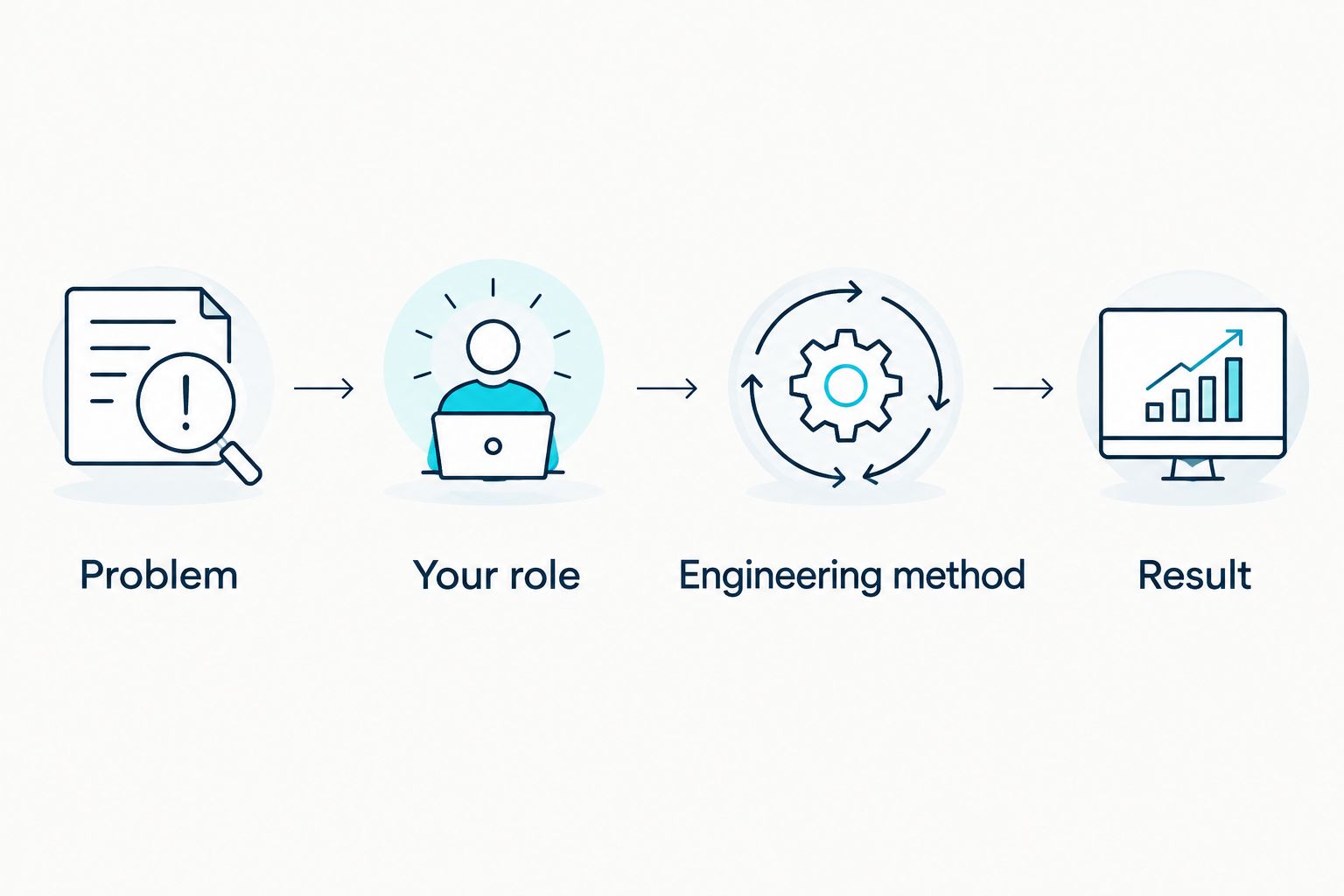
For example, “worked on electrical projects” gives no basis for judging your experience. A clearer entry identifies the kind of project, the drawings or checks you handled and the deliverable you produced. Do not add a percentage, budget or performance result unless you have a reliable basis for it. For each selected project:
- Name the project type without exposing restricted information.
- State your assigned responsibility, not the team’s full remit.
- Identify a method, tool or check you actually used.
- Describe the deliverable or outcome you can verify.
- Cut details that do not support this vacancy.
Check qualifications and registration wording
Copy qualification names from your records. If you mention ECSA, check your current registration details before stating a category or status. Do not present an application, past status or team member’s registration as your own. An employer can ask you to explain these claims, so make them easy to verify.
Keep formal credentials separate from software familiarity and project exposure. Using a tool at work does not turn it into a qualification; contributing to a project does not establish a professional registration status. In your 2026 CV, check:
- Qualification names, institutions and completion details.
- Registration status against your own current records.
- Employment dates and job titles against your history.
- Training you can document if asked.
- Technical skills you can demonstrate in an interview.
Tailor, shorten and proofread the final copy
Make a separate copy for each distinct vacancy. Put the most relevant work where a reader will see it quickly, then remove repeated duties and long descriptions of unrelated projects. Two pages are standard for most South African CVs; one page suits many school leavers, while three can suit senior roles. Do not cut essential evidence just to hit a page count.
Proofread the saved file, not only the editable draft. Check that headings remain with their content and that your contact details are correct. Before sending:
- Compare the first page with the advert’s main requirements.
- Remove skills and results you cannot explain or verify.
- Check spelling in technical terms and qualification names.
- Use a clear file name that identifies you and the document.
- Open the final file and confirm nothing has shifted or disappeared.
Which CV writing option fits your situation?
The choice is between doing the writing yourself, using a ready-made starting point and paying for done-for-you writing. All three depend on accurate information from you. None can verify your engineering work without your records and input.
| Option | Best for | Starting price | Key limitation |
|---|---|---|---|
| Write it yourself | Engineers with clear project notes who can edit their own copy | Not applicable | You must structure, tailor and proofread everything. |
| Blessing M Digital’s ready-made CV and job-search system | Engineers who want a prepared starting point | Check the current listing | It does not write or verify your project history for you. |
| Done-for-you CV writing | Engineers who need help turning notes into a finished document | Request the current scope and price | The writer still needs your accurate technical details. |
Use the ready-made option for structure; choose done-for-you writing when the wording itself is the problem. Before commissioning a service, agree on the deliverable and price in writing. For either route, review the final CV line by line before it goes to an employer.
Common mistakes engineers make
- Listing projects without a personal role. “Part of the project team” does not say whether you designed, checked, supervised or documented anything. Add the task you owned.
- Using one CV for every discipline or vacancy. Reorder your evidence for the role. Do not imply expertise in a method simply because it appears in the advert.
- Inflating registration or responsibility. State your actual ECSA status and distinguish your work from sign-off or decisions made by another engineer.
- Adding an ID number or photo by default. A full South African ID number is usually unnecessary on an initial CV. Leave it off unless there is a clear, appropriate reason to provide it.
- Filling pages with unrelated duties. In a 2026 engineering application, give relevant projects room to explain your contribution before adding older, less relevant tasks.
FAQ
How do I write a CV for an engineering job in South Africa?
Match your CV to the advert and describe your verified contribution to relevant projects. Include your qualifications, employment history, technical methods and accurate registration details.
How long should an engineer’s CV be in South Africa?
Two pages suit most South African CVs, while a senior engineer may need three. Keep evidence that supports the vacancy and cut repeated or unrelated duties first.
Should I put my ECSA registration on my engineering CV?
Include ECSA registration only with an accurate, current status you can verify. Do not describe an application or someone else’s registration as your own.
What should I write about engineering projects on my CV?
State the project type, your role, the method you used and a result you can verify. Avoid claiming the whole team’s work as your individual achievement.
Do I need a different CV for every engineering application?
Tailor the CV for each distinct vacancy. Change the profile and order of relevant projects to reflect the advert, without adding skills you do not have.
Is a ready-made CV system the same as a CV writing service?
No. Blessing M Digital’s ready-made CV and job-search system is a starting point you complete yourself; done-for-you CV writing involves someone drafting the document from information you provide.
How much does an engineering CV writing option cost?
Check the current product listing for the ready-made option and request the current scope and price for done-for-you writing. Confirm what you will receive before paying.
One last thing
Your strongest project entry is not necessarily the project with the biggest name. For a 2026 application, choose the example that most clearly proves you meet the vacancy’s requirements and can explain your own decisions. Blessing M Digital can help with CV writing, but only you can confirm which technical claims are true. Check those claims before you send the document.