

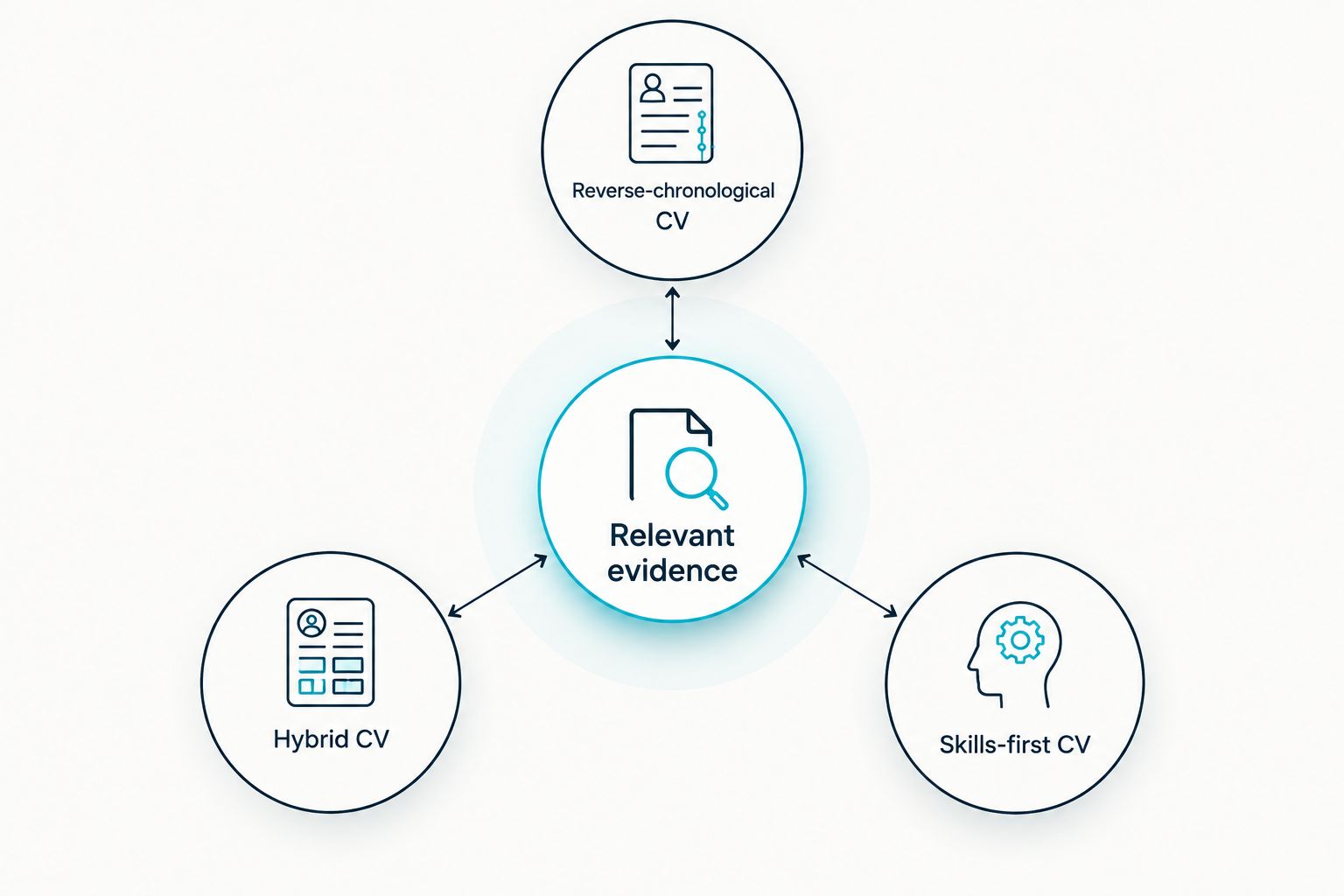
Best overall: a reverse-chronological CV. Best for graduates with substantial projects but little paid work: a hybrid CV. Best for a career change where earlier work is less relevant: a skills-first CV. The best CV format for South African graduates in 2026 makes your qualification, practical evidence and dates easy to find; choose the format that shows your strongest relevant evidence first.
- The best CV format for South African graduates in 2026 is reverse-chronological when internships or recent work support the application.
- Choose a hybrid CV when relevant projects and coursework tell a stronger story than paid work.
- Use a skills-first CV only when you can connect each claimed skill to a specific example.
- Keep dates clear, usually aim for 2 pages, and leave your ID number off the initial CV.
Why this matters
A graduate CV has a specific job: show an employer what you can do without pretending you have years of experience. Format determines whether the reader sees your qualification, internship, portfolio project or part-time work first. It does not replace evidence.
If you want a ready-made starting point rather than a done-for-you service, The South African CV & Job-Search System is a separate product from Blessing M Digital's CV writing services. You still need to choose and tailor the format for each application.
What makes the best graduate CV format?
Judge a format by these criteria before choosing one:
- Relevant evidence first: Put the qualification, internship, project or work experience most useful to this vacancy near the top.
- Clear dates: Show when you studied and worked. Do not use layout to conceal a gap or imply experience you do not have.
- Readable headings: Use plain labels such as Education, Experience, Projects and Skills so a reader can scan the page.
- Specific skills: Pair a skill with coursework, a project, volunteer work or a job task that demonstrates it.
- Easy tailoring: Change the order and detail of sections to match the role without rewriting your entire history.
- Appropriate length: In 2026, 2 pages is a practical default for most South African CVs; use the space your evidence needs, not space filled with repetition.
Graduate CV formats at a glance
| Format | Best for | Standout feature | Key limitation |
|---|---|---|---|
| Reverse-chronological CV | Graduates with relevant recent experience | Clear timeline of education and work | Less room to lead with projects |
| Hybrid CV | Graduates with strong projects and limited paid work | Puts relevant evidence before the timeline | Can repeat the same facts in multiple sections |
| Skills-first CV | Graduates changing direction | Groups transferable skills by relevance | Can make dates and experience hard to assess |
These are ways to organise the same truthful information, not different qualifications. Start by listing what you have: degree or diploma, dates, internships, projects, part-time work and demonstrable skills. Then pick the format that puts the strongest match to the vacancy where the reader will see it.
1. Reverse-chronological CV: best for relevant recent experience
A reverse-chronological CV lists your most recent education and experience first within each section. It suits a graduate whose internship, vacation work, part-time role or recent qualification supports the job application. This is the default graduate CV format for 2026 when your timeline helps explain your fit.
Put a short profile at the top, followed by Education and then Experience or Projects, depending on which is more relevant. Under each role or project, describe what you did and name the tools or methods you actually used. A graduate applying for an accounting role, for example, should make relevant accounting work or coursework easier to find than an unrelated weekend job.
Reverse-chronological CV pros:
- Makes study and work dates straightforward to check.
- Gives internships and recent roles a clear place.
- Takes little explanation from the reader.
Reverse-chronological CV cons:
- Can bury strong projects below unrelated work if you order sections poorly.
- Offers less help when your recent experience points to a different field.
Best for: Graduates with an internship, relevant part-time work or recent experience linked to the advertised role. Verdict: Choose this format first if your timeline supports your application.
2. Hybrid CV: best for strong projects and limited paid work
A hybrid CV leads with selected skills or projects, then gives education and experience in a clear dated timeline. It works when your course project, portfolio or volunteer contribution is more relevant than your paid work. The evidence appears early, but an employer can still see when and where you studied and worked.
In 2026, a graduate applying for a junior design role can place relevant portfolio projects before an unrelated retail job. That does not mean removing the retail job. Keep its dates visible and describe transferable work, such as handling enquiries, only where it helps the application.
Hybrid CV pros:
- Gives substantial projects space near the top.
- Keeps a readable timeline for education and work.
- Lets you tailor the opening section to the vacancy.
Hybrid CV cons:
- Repeats information if you describe a project in both Projects and Experience.
- Gets crowded when every coursework task receives its own entry.
Best for: Graduates whose best evidence comes from coursework, a portfolio, volunteering or independent projects. Verdict: Choose a hybrid CV when projects deserve attention before your work history.
3. Skills-first CV: best for a clear change of direction
A skills-first CV groups relevant abilities near the top, with education and dated experience below. It is useful when you are applying outside your field of study and your earlier job titles do not explain your transferable skills. Each skill still needs a concrete example.
If you studied one subject but are applying for a communications role, describe the research, writing or presentation work you completed rather than claiming broad expertise. Keep the qualification and work timeline visible. A skills-first CV must explain your experience, not hide it.
Skills-first CV pros:
- Puts transferable skills in the reader's view immediately.
- Helps connect study and work to a new field.
- Makes the reason for a career change easier to explain.
Skills-first CV cons:
- Unsupported skill lists read as claims without proof.
- Moving dates too far down makes your history harder to follow.
Best for: Graduates making a genuine change of direction who can substantiate each relevant skill. Verdict: Hold unless a chronological or hybrid CV fails to show why you fit the role.
Build the version you will actually send
In 2026, format is only the first decision. A tidy CV with generic content still leaves the employer to work out your fit. Use this sequence for each application:
- Read the vacancy. Mark the qualification, tasks and skills it asks for. Do not copy requirements you cannot meet into your CV as claims.
- Select evidence. Choose coursework, projects, internships, volunteer work and jobs that show the closest match. State your contribution rather than describing only the group's work.
- Order the sections. Lead with Education when the qualification is central; lead with a relevant project or experience section when it gives stronger proof.
- Check personal details. Include contact details an employer needs to reach you. Leave your South African ID number, photo and full street address off the initial CV unless an application specifically requires information through an appropriate process.
- Check referees. Ask people before naming them. If you include referees, 2 or 3 people who can speak to your work or study are a practical choice; keep their details accurate.
- Read the final file. Check dates, spelling, contact details and the employer's submission instructions. Do not send an unedited master CV to every vacancy.
A school leaver can often make a useful CV in 1 page; most South African CVs sit at about 2 pages, while 3 pages better suits someone with substantial senior experience. A recent graduate should not expand a thin work history simply to hit a page count. Cut repeated duties and unsupported skill lists before cutting relevant projects.
Blessing M Digital's CV writing services are done-for-you services, not the same thing as its ready-made CV and job-search product. If you want help writing rather than a resource to work through yourself, check the service scope before choosing. Neither option changes the need for accurate dates and examples.
How these formats were ranked
Reverse-chronological ranks first because it presents a graduate's education and recent experience in an easy-to-check timeline. Hybrid ranks next because it can show projects earlier without losing that timeline. Skills-first comes last because it demands the most care: every prominent skill needs evidence, and dates must remain visible.
The order is a default, not a rule that overrides the vacancy. If the strongest proof for a role is a project, choose hybrid. If your internship directly matches the role, choose reverse-chronological. In 2026, the best format is the one that shows relevant evidence clearly without obscuring your history.
Which graduate CV format should you choose?
Choose a reverse-chronological CV unless your projects are clearly more relevant than your recent jobs. In that case, choose hybrid and keep the timeline visible. Reserve skills-first for a change of direction you can support with examples, not as a way to make limited experience look larger.
Blessing M Digital offers CV writing services, but a graduate can make the format decision before considering outside help. Write down your strongest evidence for the role, choose the matching structure above, and check every claim against work you actually completed.
FAQ
What's the best CV format for South African graduates in 2026?
A reverse-chronological CV is the best default for South African graduates in 2026 when recent study or experience supports the role. Choose a hybrid CV if relevant projects deserve more space near the top.
Is a hybrid CV better than a chronological CV for a graduate?
A hybrid CV is better when projects or coursework show your fit more clearly than your work history. Keep dated education and experience sections so the employer can still follow your timeline.
Should a graduate use a skills-first CV?
Use a skills-first CV for a genuine change of direction when you can give an example for every prominent skill. Do not use it to conceal dates or replace evidence with a list of claims.
How long should a South African graduate CV be?
Aim for about 2 pages if you have enough relevant education, projects and experience to fill them. Use less space when your evidence is brief rather than adding repetition.
Should I put my South African ID number on my CV?
Leave your ID number off the initial CV unless an application specifically requires it through an appropriate process. Your CV needs useful qualifications and contact details, not unnecessary sensitive information.
How many referees should I put on a graduate CV?
Include 2 or 3 referees if the application asks for them or you choose to list them. Ask each person first and check that their contact details are correct.
Can I use the same graduate CV for every job application?
Use one master CV as a starting point, then tailor the section order and evidence to each vacancy. Do not claim skills or experience you cannot demonstrate.
One last thing
A graduate CV does not need a longer skills list; it needs better proof. Before sending your 2026 application, pick the claim nearest the top of the page and ask what project, task or qualification backs it up. If you cannot answer, rewrite or remove the claim.