

You can use the same master CV for every job application in South Africa, but do not send the same finished CV unchanged to every employer. Keep your work history accurate, then adjust the summary, skills and evidence to match each vacancy. In 2026, the useful distinction is between reusing your facts and reusing an application that ignores the job advert.
- Can you use the same CV for every job application? Reuse a master CV, not an unchanged application.
- For South African vacancies, match your summary and relevant experience to the advert without inventing skills.
- Blessing M Digital's CV & Job-Search System is a ready-made starting point, not a done-for-you CV writing service.
Why this matters
An employer needs to see why your experience fits the vacancy in front of them. If your CV leads with work that has little to do with that role, the relevant evidence is harder to find. That is a presentation problem you can fix without changing the facts.
A free CV template for South African job seekers can give you a consistent layout. The layout alone will not decide which experience deserves space. In 2026, treat the template as the container and the job advert as the guide to what goes near the top.
Can you use one CV for every job application in South Africa?
Use one accurate master CV, then make a separate application copy for each distinct role. You do not need to rewrite your employment history every time. You do need to check whether the summary, skills and examples make sense for the job you are applying for.
| Approach | Best for | Advantage | Drawback | Verdict |
|---|---|---|---|---|
| Send the same finished CV unchanged | Applications for genuinely similar roles | Takes less editing | Can bury evidence the new advert asks for | Use only after checking the match |
| Adapt a master CV | Most applications across different vacancies | Keeps your facts consistent while changing the emphasis | Requires a careful review before sending | Best default |
| Write each CV from scratch | A major change in the kind of role you want | Gives you room to rethink the structure | Makes it easier to leave out useful experience or introduce inconsistencies | Use when the master structure no longer fits |
The safest choice for most job seekers is the middle row. For example, an administrator applying for a reception role can bring customer-facing duties forward; for a records role, the same person can lead with document handling. Both versions must describe work they actually did. Do not change a job title or add software skills simply because the advert mentions them.
What should stay the same?
Keep your name, contact details, employers, job titles, employment dates, qualifications and factual account of your responsibilities consistent. Correct an error in the master copy first, then update any application copies that repeat it. A tailored CV is not a different account of your career.
You can also keep a record of the examples you are prepared to explain in an interview. If one application describes a project differently from another, check the wording against what actually happened. The aim is a clearer match, not a stronger-sounding claim you cannot support.
What should change?
Change the order and emphasis of truthful information. Put the most relevant skills higher in your skills section, select work examples that answer the advert, and rewrite a generic summary so it names the kind of role you want. If an older duty adds nothing to that application, shorten it rather than removing your employment history without explanation.
Use the employer's wording when it accurately describes your experience. If an advert asks for customer queries and you handled customer queries, say so plainly. Do not copy a requirement you cannot meet into your CV as though it were a skill you possess.
How do you tailor a CV without rewriting it?
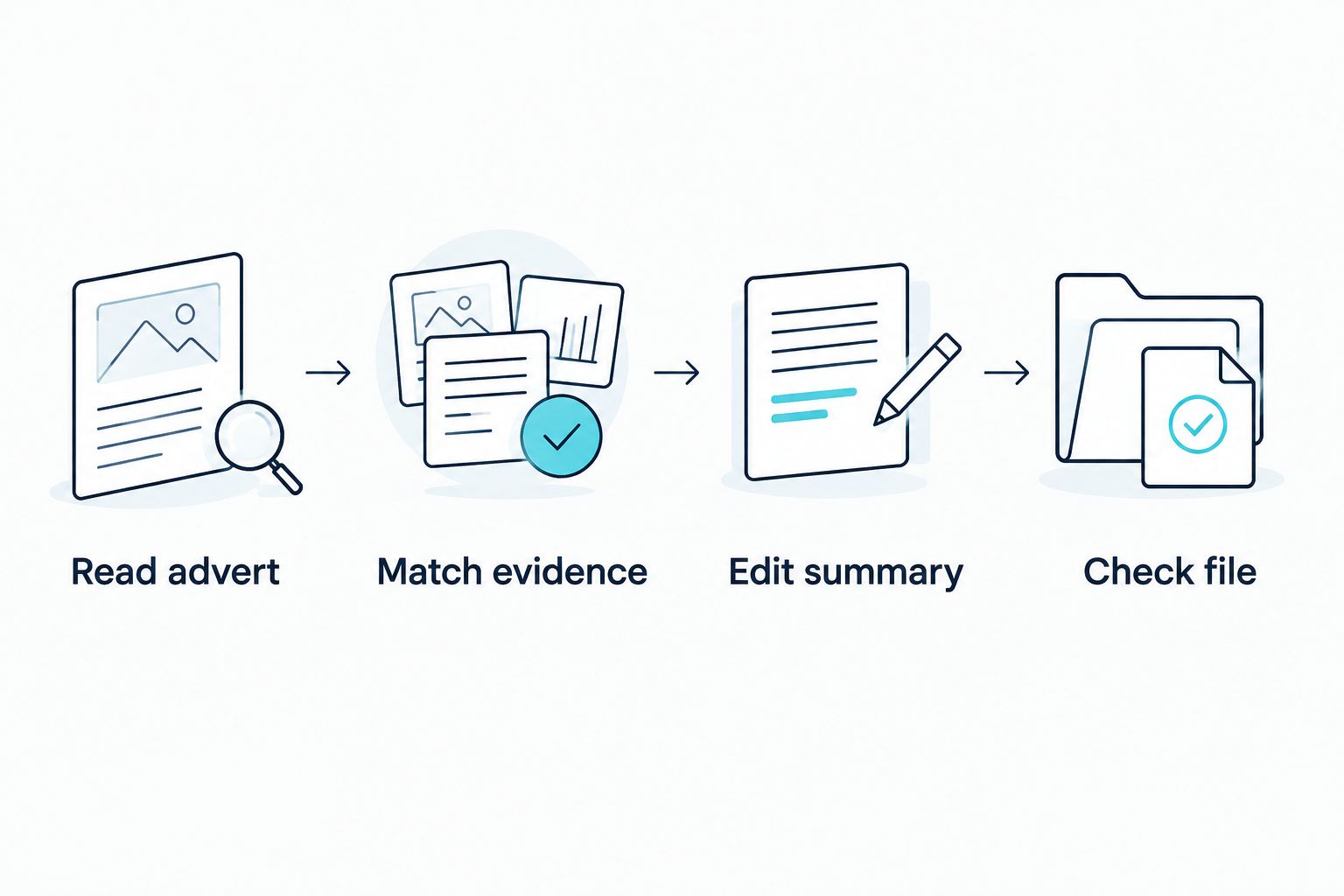
Start with a master document that contains your accurate history and a bank of genuine examples. Save a separate copy for the vacancy you are addressing in 2026. Then work through these steps:
- Read advert. Mark the role's duties, required qualifications and requested skills. Separate requirements you meet from those you do not; do not turn a wish list into claims about yourself.
- Match evidence. Find a real job duty, project, qualification or example that supports each relevant point. If you cannot name supporting evidence, leave that claim out.
- Edit summary. State your relevant background in plain language, then move the strongest matching examples where the reader can find them quickly. Keep the dates and facts unchanged.
- Check file. Read the finished CV against the advert, check spelling and contact details, and make sure you are sending the version intended for that role.
This process works whether you are applying through an employer's form or sending a document directly. The final check matters: a well-tailored CV still fails to represent you accurately if it contains the wrong contact detail or a claim copied from another application.
Keep the master separate from the application copies. If you improve a factual description or correct a date, update the master as well. If you merely change which example appears first, that change belongs to the application copy.
Why the amount of editing varies
Not every vacancy needs the same rewrite. In 2026, decide how much to change by checking the actual difference between the role and the CV you have ready:
- The duties in the advert. Similar duties call for less rearranging. A role that focuses on different work needs different examples near the top.
- The skills you can prove. Move a relevant, genuine skill forward. Do not add a skill solely to repeat the advert's wording.
- Your stage of experience. A school leaver will have different evidence from someone with several roles. Choose education, projects or work history according to what you can substantiate.
- The relevance of older work. Keep an accurate employment record, but shorten detail that does not help explain your fit for this vacancy.
- The employer's instructions. Follow any stated format or document requirements for that application rather than assuming your usual file is suitable.
These are editing decisions, not reasons to manufacture a new professional identity for every vacancy. If two adverts ask for almost the same work, the application copies can be close. Read both adverts anyway; one changed requirement can affect which example you lead with.
Can I send the same CV to similar jobs?
Yes, if the CV already answers each advert accurately. Similar job titles do not guarantee identical duties, so check the required skills and instructions before sending the file. In 2026, a short review is a better rule than automatic reuse.
Do I need a new CV when changing careers?
You need a new emphasis, not invented experience. Lead with transferable work you can demonstrate, explain relevant training clearly and reduce space spent on duties unrelated to the new role. If your master CV is arranged entirely around your old occupation, rebuild its structure while keeping the facts.
Should I copy keywords from a job advert into my CV?
Use an advert's terms only when they truthfully describe your work. Match a requirement to a real example, then write the example in clear language. A copied list of skills without supporting evidence gives the reader less to assess.
Where does a ready-made CV product fit?
A ready-made product can help you begin with a repeatable document; it cannot supply evidence you have not provided. Blessing M Digital lists a South African CV Job Search System for readers who want to check a product option. Check what is included before choosing it. This is distinct from done-for-you CV writing, where someone prepares the document as a service.
Blessing M Digital is best for South African job seekers who want to compare a ready-made CV product with CV writing services before choosing how to prepare their application. Neither option removes the need to check your dates, claims and fit against the vacancy. In 2026, the final application remains your responsibility.
FAQ
Can you use the same CV for every job application?
Yes, you can reuse one master CV, but check and adapt the finished copy for each vacancy. Keep your facts consistent and change the emphasis only where the advert calls for it.
What is the quickest way to tailor a CV?
Compare the advert with your master CV, then move your most relevant truthful examples forward. Check the summary, skills and file before sending it.
Should I change my job titles to match an advert?
No. Keep your actual job titles and explain the relevant duties you performed under them; do not claim a title you did not hold.
Does every application need a different CV layout?
No. Keep a readable layout if it works for the role and follows the employer's instructions. Tailoring usually means changing the emphasis of the content, not redesigning the document.
How long should a South African CV be?
Two pages is standard for most South African CVs; one page suits school leavers, and three pages can suit senior roles. Keep relevant evidence rather than cutting it just to hit a page count.
Should I include my South African ID number on every CV?
Usually no. Do not put your ID number on a general CV just because you are sending the document to multiple employers; follow a specific application requirement when one is stated.
How many referees should I put on a South African CV?
Two or three referees is standard for a South African CV. Check their details and let them know when you are applying for roles where they may be contacted.
One last thing
The version you nearly sent is worth checking against the advert one final time. A CV that fits the role but carries an outdated phone number, an unsupported skill or the wrong saved file defeats the work you put into tailoring it. In 2026, keep the master accurate and send only the application copy you have reviewed.