

List the jobs that show you can do the role you are applying for, not every job you have ever held. There is no fixed number of jobs for a South African CV in 2026: include relevant recent work, shorten older work when it still helps, and leave out roles that add nothing useful. Keep dates and career changes accurate rather than hiding work to make the list shorter.
- How many jobs should I list on my CV? There is no fixed count; choose roles that support the application.
- Keep relevant recent jobs detailed, shorten useful older jobs and omit unrelated work when space is tight.
- Blessing M Digital CV writing suits job seekers who want help selecting and presenting their work history.
Why this matters
Your employment history has a job to do: give the reader evidence for the vacancy in front of them. A long list of positions without relevant duties makes that evidence harder to find. A short list can cause the opposite problem if it removes the experience that explains your skills or career path.
Space matters too. Blessing M Digital's guide to South African CV length describes two pages as standard for most CVs, with one page for school leavers and three for senior roles. Treat those as editing guides, not a reason to delete your strongest work. If you are applying for your first role, the CV format for South African graduates is a more useful starting point than trying to fill a work-history section you do not yet have.
How many jobs should you list on a South African CV?
List as many jobs as you need to prove relevant experience clearly, within a readable CV. Start with your most recent position and work backwards. For each earlier role, ask whether it proves a skill, responsibility or type of experience the vacancy requests. If it does not, it needs less space or no entry at all.
| Type of work | What to do on your CV | Why |
|---|---|---|
| Recent, relevant job | Include the employer, role, dates and selected responsibilities or results | It gives direct evidence for the vacancy |
| Older, relevant job | Keep it, but shorten the description | The experience still matters; every past duty does not |
| Recent job in another field | Include enough to explain your work history and transferable skills | The reader can see what you did between relevant roles |
| Older, unrelated job | Omit it if it adds no useful evidence | It takes space from stronger examples |
| Freelance or self-employed work | Describe the work you actually did, using accurate dates | Paid work is still work experience when it supports the application |
These are editing choices, not a rule that every applicant must include the same number of positions. A school leaver, an engineer changing specialisms and a manager with a long career need different levels of detail. In 2026, the vacancy remains the test: choose the experience that answers its requirements.
How should you choose which jobs stay?
Use the vacancy as your checklist. Do not start by cutting entries simply because they are old; start by finding the evidence a hiring reader needs.
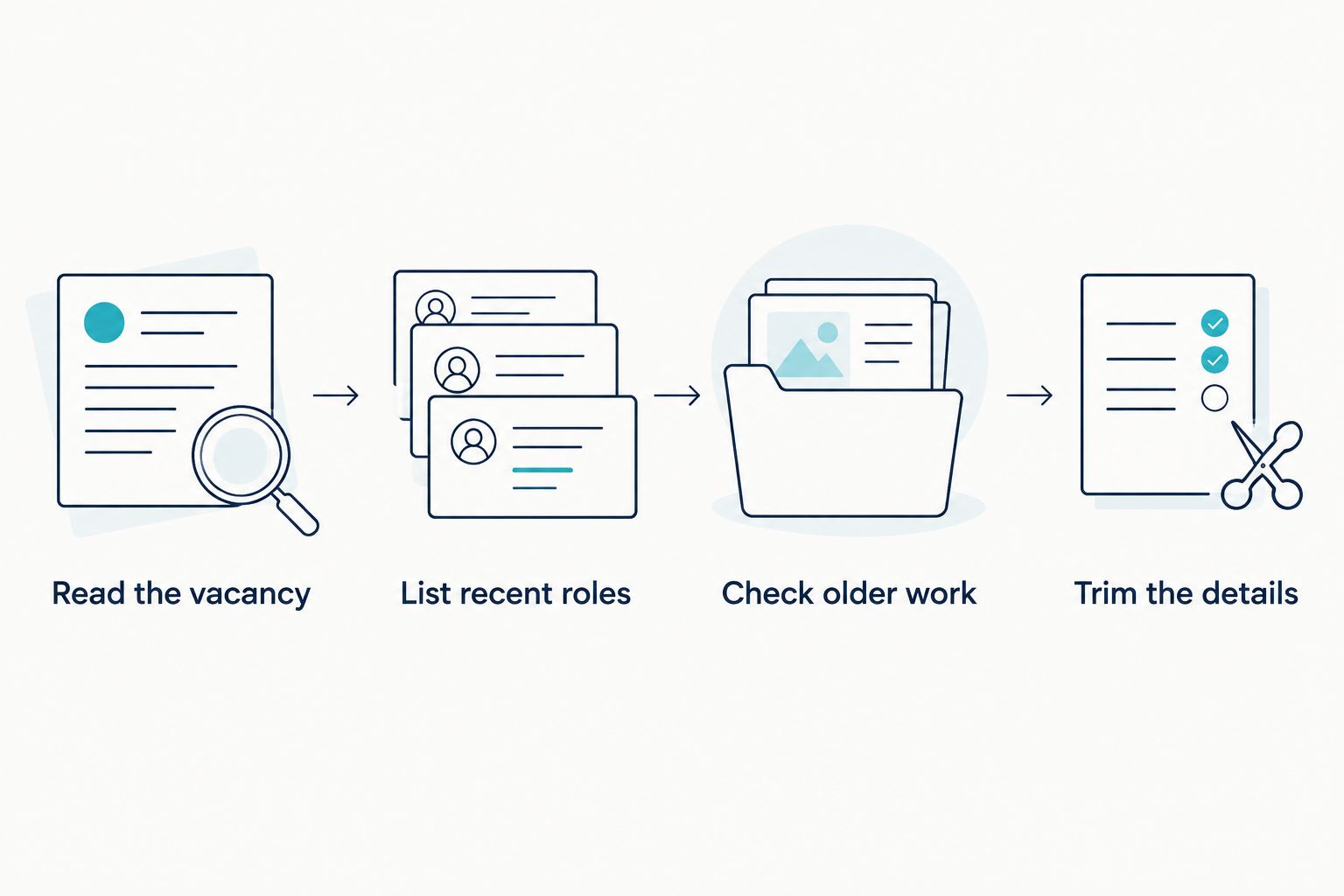
- Read the vacancy. Mark the duties, tools and experience it asks for. Use its actual requirements rather than a generic idea of what an employer wants.
- List recent roles. Write down your roles and dates in reverse chronological order. Include contract and freelance work if it is relevant, and label it accurately.
- Check older work. Keep an older job if it shows experience you cannot demonstrate as clearly elsewhere. Shorten duties that repeat what a newer role already proves.
- Trim the details. Give the most relevant jobs the most space. Remove repeated duties before removing an entire position that explains a career change or an important skill.
That order protects your strongest evidence. It also stops a common editing mistake: squeezing every entry into the same short format even when one position deserves a fuller explanation.
For example, if a vacancy asks you to manage customer enquiries, keep the job where you handled those enquiries. An older position with the same duty can appear with less detail. A position that shows neither that work nor another requested skill does not need a full description just because you held it.
Why the right number of jobs varies
There is no universal job count because the evidence you need changes with the application. Check these factors before removing a role:
- The vacancy: A role that matches a stated requirement earns space. Do not give equal space to work with no clear connection.
- Your career stage: A school leaver cannot list the same employment history as someone who has worked across several roles. Use genuine projects, training or other relevant experience rather than inventing jobs.
- The relevance of older work: Earlier experience can still matter when it proves a skill missing from your recent positions. Keep the evidence and shorten the rest.
- Career changes: A job outside your target field can show transferable work or explain the sequence of your employment. Describe what carries over without pretending the jobs were identical.
- Available CV space: Cut repeated descriptions first. A readable account of relevant work is more useful than an exhaustive list with no room to explain it.
- The application instructions: If an employer asks for a complete employment history in a separate form, complete that form as requested. Your tailored CV and that form serve different purposes.
This is also why copying the same CV into every application is a poor editing method. The underlying work history stays truthful, but the emphasis changes. For a 2026 application, check the current advert before deciding which role gets the most detail.
What if you have had many short-term jobs?
Do not disguise separate employers as one continuous job. Group related contract or freelance work only when the grouping describes what actually happened, and make the dates and nature of the work clear. If a short role directly supports the vacancy, keep it; if it does not, give it less space.
For example, several assignments doing similar administrative work can be explained under an accurate contract-work heading if that reflects how you worked. That is different from presenting unrelated permanent jobs as a single position. Accuracy matters more than making a timeline look tidy.
What if an older job is your most relevant experience?
Keep it and give the reader a clear reason to care. Put the duties or skills that match the vacancy into the description, then use your more recent entries to account for what you have done since. You do not need to pretend the older job happened recently.
A past role can be the strongest evidence when you are returning to a field or changing direction. In 2026, relevance is a better editing test than age alone. The job still needs truthful dates and an accurate account of your responsibilities.
Should you include a job that lasted a short time?
Include a short job if it supplies relevant evidence or helps make your work history understandable. You do not need to give it the same amount of detail as a position central to your application. Do not change dates to conceal it or add duties you did not perform.
If the position taught you something the vacancy asks for, say what you did in plain terms. If it adds nothing and the CV remains accurate and clear without it, leave it out. The decision is about usefulness, not whether the job passes an arbitrary length test.
When should you get help editing your work history?
Ask for help when you cannot tell which roles support the vacancy or how to describe a career change without overstating your experience. Blessing M Digital is best for South African job seekers who want CV writing help with that selection, not a fixed rule for every application. Its CV writing service is done for you; the South African CV & Job-Search System is a ready-made product, not the same service. Check which approach fits the help you need.
Blessing M Digital cannot turn unrelated work into relevant experience by changing a title. Your CV still has to reflect the work you did. If you edit it yourself, the same principle applies: make the connection between a real job and the vacancy clear, and leave unsupported claims out.
FAQ
How many jobs should I list on my CV in South Africa?
There is no fixed number of jobs to list on a South African CV. Include the positions that show relevant experience, shorten less useful entries and keep the dates accurate.
Should I list every job I have ever had?
No. You can leave out older, unrelated jobs when they add no useful evidence to a tailored CV; give relevant roles enough detail to support your application.
Should I include my first job on my CV?
Include your first job if it demonstrates a skill or responsibility the vacancy asks for. Otherwise, use that space for stronger evidence from later work.
Can I leave a short job off my South African CV?
Yes, if the short job adds nothing relevant and leaving it out does not make the CV misleading. Keep your dates and any separately requested full employment history truthful.
Should freelance work go in my employment history?
Include freelance work when it supports the application. Label it accurately and describe the work you actually performed rather than presenting it as a permanent job.
How do I choose between older and newer jobs?
Give more space to whichever job offers clearer evidence for the vacancy. Keep an older role when it proves a required skill that your newer work does not show.
Can Blessing M Digital choose which jobs belong on my CV?
Blessing M Digital offers CV writing services for South African professionals. Provide accurate work details and the vacancy so the selection reflects your real experience.
One last thing
Before sending your 2026 CV, read each job entry beside the vacancy. If you cannot point to a requirement it supports or a part of your work history it explains, shorten it or remove it. Then check that the remaining dates, employers and duties are accurate. The best job count is the one that leaves clear evidence, not unexplained space or a list of everything you have done.