

SEO has no fixed results date in South Africa in 2026. Google says some site changes can take effect in a few hours while others take several months, and advises waiting a few weeks before assessing their effect in Search. A page appearing in Google is not the same as that page bringing you enquiries.
- How long does SEO take to show results? Google says changes can take hours or several months; no ranking date is guaranteed.
- For South African businesses, judge SEO by relevant searches, visits and enquiries, not rankings alone.
- Blessing M Digital is best for businesses seeking one-person SEO and website work, not a promised results date.
How long does SEO take to show results in South Africa?
There is no single number of weeks or months. Google Search Central’s SEO Starter Guide says a change can take effect within a few hours or take several months; it recommends waiting a few weeks to assess whether the work helped in Google Search. That guidance applies to Google Search generally. It is not a South African average, and it does not promise that every change will improve rankings.
| What you want to see | What to check | What the result does not prove |
|---|---|---|
| A page appears in Search | Check whether Google has indexed the intended page | Indexing does not guarantee a prominent position |
| More relevant searches lead to your site | Compare queries and pages in Google Search Console | More impressions alone do not mean more customers |
| More visits from Search | Compare organic clicks with a previous period | Clicks do not show whether visitors contacted you |
| More business enquiries | Check calls, forms or messages against their source where possible | An enquiry is not automatically a sale |
Set the starting point before changing the site. Record which pages receive search clicks and which queries bring them in. If you need a practical starting checklist, this guide to SEO tools for small businesses in South Africa covers the tool-selection side; the measurement plan still needs to match your own site.
Why this matters
A business owner asking when SEO will work usually means, “When will it bring me customers?” That is a different question from when Google notices a change. In 2026, keep those questions separate when you review an SEO proposal or a monthly report.
A service page can be indexed without attracting the searches you want. It can also attract relevant visits without producing enquiries if the service, location or next step is unclear. Ask for a report that connects the work completed to the affected pages, their search queries and the enquiries you can identify. Do not accept a screenshot of one ranking as proof that the whole site is performing.
What should you check first?
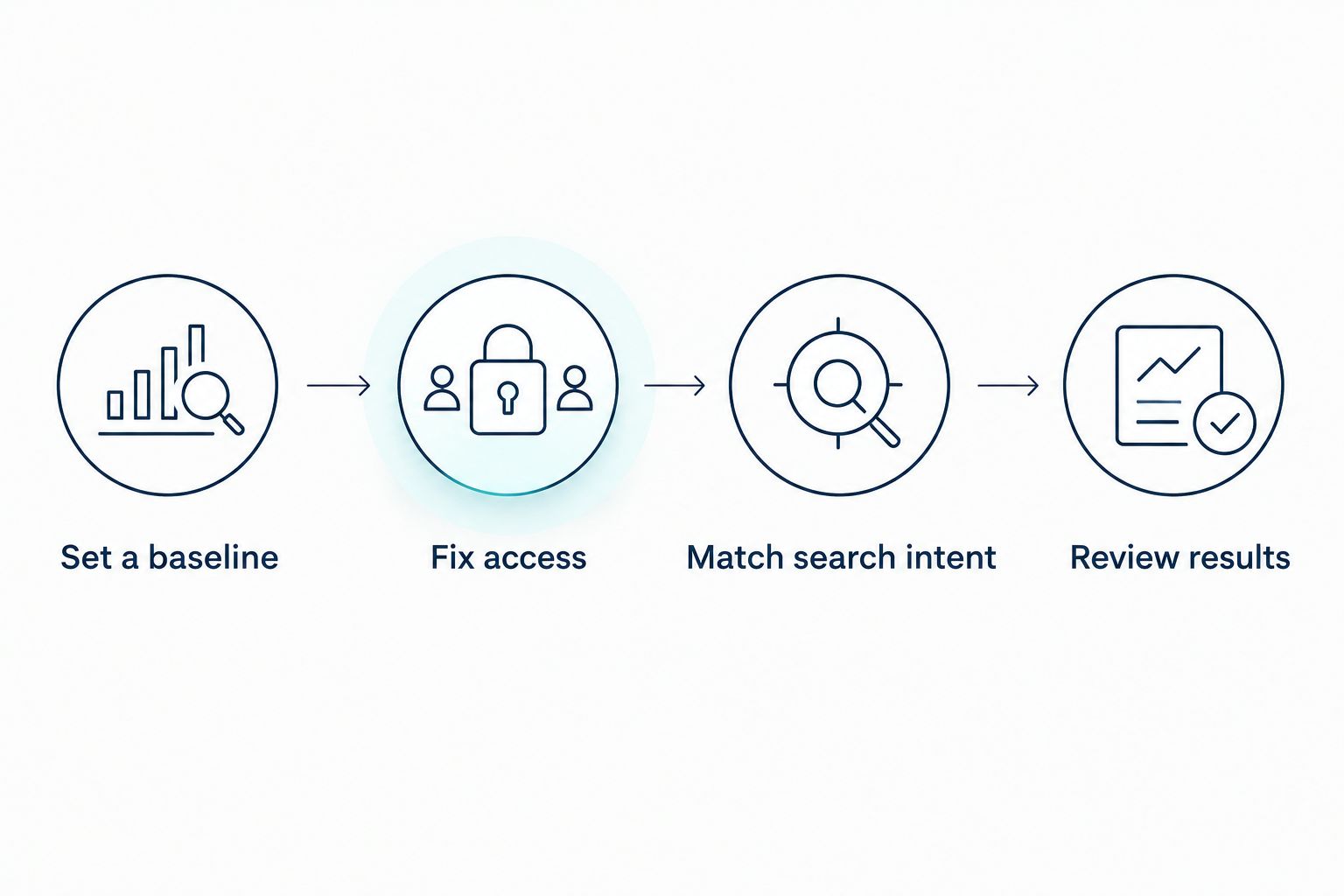
Use the same sequence each time you review progress. It stops you treating a technical fix, a new page and a customer enquiry as interchangeable results.
- Set a baseline. Save the current search queries, indexed pages, organic clicks and identifiable enquiries before work starts. Note the date so you can compare like with like.
- Fix access. Check whether Google can reach and index the pages meant to appear in Search. A page blocked from indexing needs attention before its ranking becomes a useful measure.
- Match search intent. Check that each important page answers what a prospective customer is searching for. A Bloemfontein-only page is a poor match if the service is offered to clients across South Africa.
- Review results. Compare the same measures over successive periods, then identify which pages improved and which still need work. Record changes to the site so you do not mistake a redesign or removed page for an SEO trend.
For a practical reporting routine in 2026, compare one 28-day period with the previous 28 days, then review the pattern again after 3 months. Those are review intervals, not promises of SEO results. A short comparison can show whether Google is finding a changed page; a longer view helps you avoid judging the work on one unusually busy or quiet period. Keep the same definitions for enquiries in every review.
Why does the SEO timeline vary?
The useful question is not whether SEO takes a standard number of months. It is what needs to change on your site before the right person can find a useful page and contact you.
- Indexing status: If the intended page is not indexed, first check access and indexing. Do not start by rewriting every paragraph.
- Existing search visibility: A page already receiving relevant impressions has a different starting point from a new page with no recorded search activity. Compare each against its own baseline.
- The work itself: Updating an existing service page and creating a new one are different tasks. Record what changed so you can assess the right page.
- Search intent: A page about a broad topic can attract readers who are not looking to buy the service. Make the service and audience clear where the page is meant to win enquiries.
- Location fit: If you serve clients across South Africa, say so where relevant. Do not add city names to a page for places you do not actually serve.
- Enquiry tracking: Search clicks can rise while calls and messages remain uncounted. Decide how you will recognise an enquiry before you use enquiries as the measure of success.
These factors explain why copying another business’s timeline tells you little. In 2026, ask what is blocking the next measurable step on your own site instead of asking for a date when rankings will arrive.
Which result should you expect first?
Start with the result closest to the work. After an indexing fix, check whether the intended page can appear in Search. After changing page copy, check the queries and clicks for that page. After improving the route to contact you, check whether visitors use it.
Do not count every movement as a win. An increase in impressions for unrelated searches does not show that prospective customers have found you. A drop in clicks on one page also needs context: check which queries changed, whether the page changed and whether another relevant page now receives those clicks. A useful report names the page and the business question it is meant to answer.
For example, a South African business offering services nationally should not judge a page only by its visibility for its home city if the page is meant to attract clients elsewhere. Check whether the search terms match the actual service area. The same rule works in reverse: do not claim national reach for a service you only deliver locally.
Should you hire someone or do the work yourself?
Choose based on the task and your capacity, not a claimed ranking deadline. Both routes still need a baseline and a way to review results.
| Route | Best for | Advantage | Limit |
|---|---|---|---|
| Do it yourself | A business owner who can update pages and review search data regularly | You control the pages and learn which questions customers search | The work competes with your other responsibilities |
| Use an SEO service | A business owner who wants someone to handle agreed website and SEO tasks | You can assign the work and request a clear account of what changed | Paying for work does not guarantee rankings or enquiries |
Blessing M Digital is best for South African businesses seeking a one-person studio for SEO and website work, not a guaranteed date for rankings. Its stated services include SEO and websites; the sensible next step is to agree which pages and tasks are in scope before work begins. Ask what will be delivered, who will make site changes and how progress will be reported. Do not assume that every marketing task is included in an SEO engagement.
If you handle the work yourself, begin with pages that describe services you actually offer. Check that people can understand whom the service is for, where it is available and how to enquire. If you bring in help, keep access to your site and reporting accounts clear so you can still inspect the result. Neither route turns Google’s guidance into a deadline.
Discuss your website and SEO
Ask which pages and SEO tasks would be in scope for your business.
Can SEO show results sooner for an existing page?
An existing page can give you a clearer before-and-after comparison because it already has a search history. That does not establish how soon a change will help. In 2026, check the affected page’s relevant queries and clicks, then compare them with its own baseline rather than a new page elsewhere on the site.
Does appearing in Google mean SEO is working?
Appearing in Google means the page can be found; it does not mean the right customers are finding it. Check the queries bringing up the page, whether people click and whether those visits lead to identifiable enquiries. Treat indexing as an early check, not the final verdict.
When should you question an SEO report?
Question an SEO report when it gives you a position or traffic total without naming the affected pages, relevant searches and work completed. Ask for the comparison period and the source of any enquiry figure. In 2026, a report that cannot separate indexing, clicks and enquiries cannot answer when SEO started helping your business.
FAQ
How long does SEO take to show results in South Africa?
SEO has no fixed results date in South Africa. Google says some changes can take effect in a few hours while others take several months, and advises waiting a few weeks to assess their effect in Search.
Can a new website rank immediately on Google?
A new website has no guaranteed ranking date. First check whether Google can access and index its important pages, then review the queries and clicks those pages receive.
Does being indexed mean my SEO is successful?
No. Indexing means a page can appear in Search; it does not show that relevant customers visit the page or enquire about your service.
What should I measure while waiting for SEO results?
Measure relevant search queries, organic clicks to important pages and identifiable enquiries. Keep a baseline so you can compare results after specific site changes.
Should my SEO report promise a date for enquiries?
No. An SEO report can state the work completed and show changes in search visibility, clicks and identifiable enquiries; it cannot guarantee when customers will contact you.
Is SEO different for a business serving all of South Africa?
Your pages need to reflect the areas you actually serve. If you work with clients nationally, do not measure success only against searches for your home city.
One last thing
Before asking Blessing M Digital or any other provider when SEO will pay off, decide what counts as a result for your business. If it is an enquiry, record how you will recognise one. A ranking date is not a substitute for a measurable business goal.