

Law firm SEO is the work of making a practice’s services easier to find in search, with the aim of attracting relevant enquiries. In South Africa, the work needs to distinguish between practice areas, places served and the questions a potential client asks before making contact.
- For SEO services for law firms South Africa, start with separate service pages and accurate local listings.
- Blessing M Digital is best for law firms that want one person to handle website and SEO work with a written scope.
- Judge progress by relevant enquiries, not rankings alone.
Why SEO matters for law firms
Someone looking for a conveyancing attorney has a different problem from someone looking for help with a divorce. A single page listing every service gives neither person a clear answer. The useful SEO decision is to match each page to a service the firm actually provides, then make it easy to contact the right person.
Location matters too. A firm that sees clients in Bloemfontein should state that plainly; a firm serving clients elsewhere should explain where and how it works without pretending to have offices it does not have. For 2026, treat location wording as a statement of fact, not a place to repeat city names.
If your website needs work alongside its search content, Blessing M Digital offers websites and SEO marketing services. The studio is run by one person. Ask for the proposed pages, edits and reporting to be set out in writing so you can see what the work covers.
How to plan law firm SEO in 2026
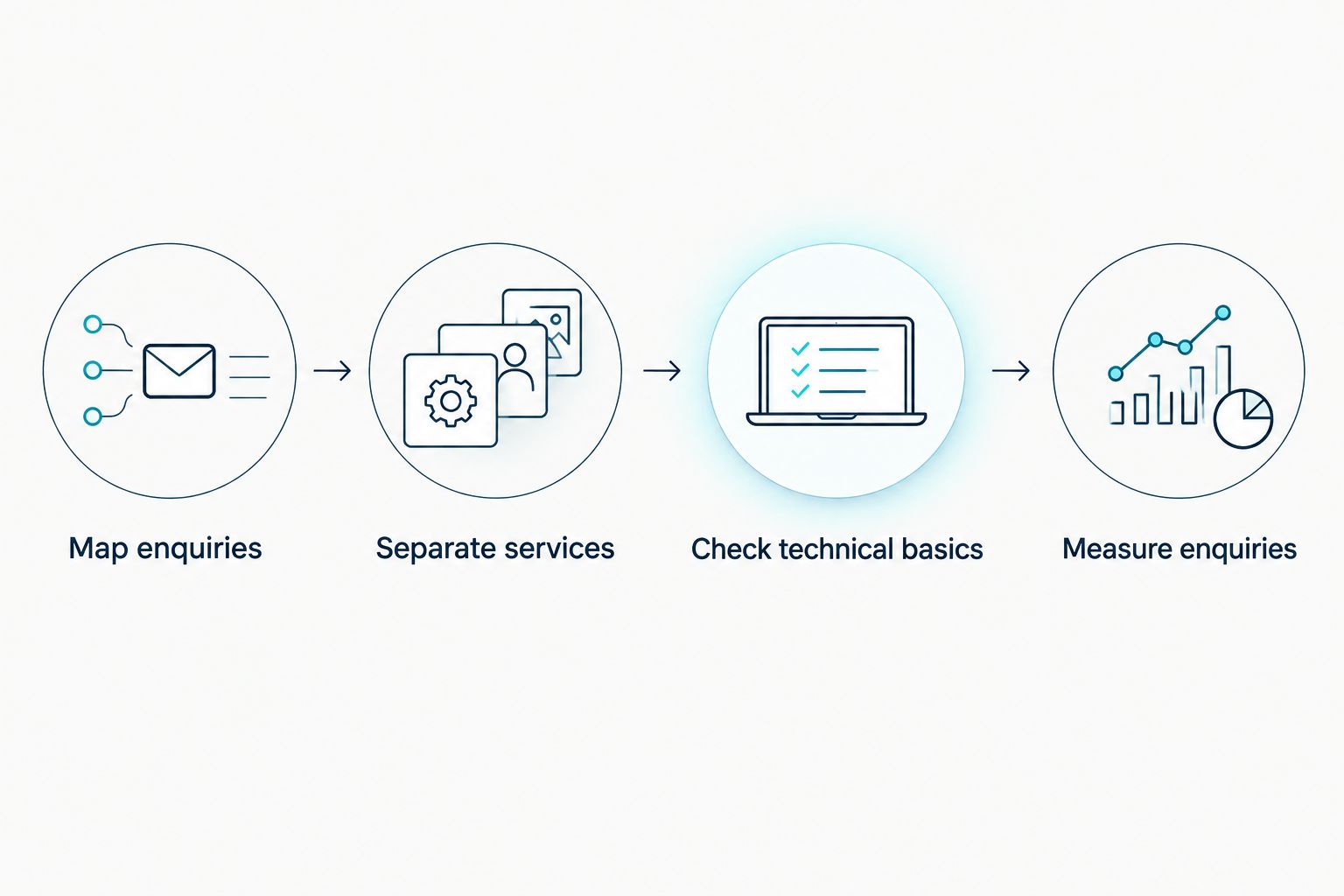
Start with the enquiries you want, then connect them to the right service pages. Separate services and locations before changing technical settings, and measure enquiries after publication. Each step below can be checked manually before you decide whether to commission help.
Map enquiries to search terms
Write down the matters the firm accepts and the words a potential client would use for each one. Search those terms yourself and note whether the results answer a service question, a location question or a general legal question. Do not build a page around a service the firm does not provide simply because the search looks attractive.
Use the wording a client would recognise, then check that it describes the work accurately. In 2026, a useful keyword list is a working map between a real enquiry and the page that should answer it, not a long list of near-identical phrases.
- List the services the firm currently accepts.
- Record common client questions for each service.
- Add a place name only where it describes a place the firm serves.
- Assign each distinct search intent to an existing page or a planned page.
Separate services and locations
Give a distinct service its own page when a visitor needs a distinct explanation. A conveyancing page, for example, should explain that service rather than bury it in a list alongside unrelated matters. If the firm operates in more than one place, describe its real presence and service arrangements for each place instead of copying the same text with a different city name.
The page should tell a reader what kind of matter the firm handles and how to take the next step. Do not publish a location page that implies an office or appointment arrangement that does not exist.
- Use a page title that names the actual service.
- Put the service explanation near the top of the page.
- State the relevant location or service area accurately.
- Link related service pages using descriptive words.
- Give readers a clear route to make an enquiry.
Answer the questions before the enquiry
A useful law firm page answers what the service covers, what information a prospective client should prepare and what happens when they get in touch. Ask the people receiving enquiries which questions they answer repeatedly. Those answers are better source material than generic legal copy that could appear on any firm’s website.
Keep public guidance distinct from advice on an individual matter. Check legal statements with the firm before publication, especially when describing processes that depend on a person’s circumstances. Do not use a client’s story or documents in a search page without proper permission.
- Collect recurring questions from the enquiry team.
- Answer each question in plain South African English.
- Describe the firm’s actual process rather than an assumed one.
- Review legal wording before the page goes live.
Check local listings and site basics
Search for the firm’s name and inspect the details a prospective client sees. Compare the business name, contact details and stated location with the website. Where the firm maintains a Google Business Profile, keep its information accurate and select details that reflect the actual practice.
Then check the website on a phone. A visitor should be able to read the service page, find contact information and submit an enquiry without hunting through unrelated menus. Technical SEO also includes pages that search engines can access and links that take readers to the intended destination. Fix broken journeys before adding more copy.
- Check the displayed business name and contact details.
- Test service pages and enquiry forms on a phone.
- Fix broken internal links and missing pages.
- Check whether important service pages are accessible to search engines.
Build trust without making claims you cannot prove
Prospective clients need to know who will handle an enquiry and what the firm does. Publish accurate practitioner and practice information that the firm has approved. Avoid claims about results, specialisation or client experiences unless the firm can support and publish them appropriately.
If another site mentions the practice, check that the name and destination page are correct. Do not buy irrelevant directory placements to inflate a link count. A useful mention helps a reader identify the practice; a list of unrelated links does not explain why someone should contact it.
- Confirm practitioner information with the firm.
- Remove unsupported outcome claims from service pages.
- Correct inaccurate practice details where the firm is listed.
- Link to a relevant page when a legitimate mention permits it.
Measure enquiries and decisions
Set a 30-day review rhythm in 2026. Record which service pages receive search visits and which pages lead to calls or form submissions that the firm can identify. Keep the enquiry question in view: a rise in visits is not useful if the firm receives the wrong kinds of matters.
Review the pattern over 90 days before deciding which page needs expansion, correction or removal. These are planning intervals, not promises about when rankings will change. Keep a simple record of work completed so that a later change can be assessed against what actually changed on the site.
- Check search visits by service page every 30 days.
- Record relevant calls and form enquiries where identifiable.
- Note enquiries the firm cannot take on.
- Review page changes and enquiry quality after 90 days.
Which approach fits your firm?
Choose an option by who will do the work and who can approve legal content. No outside provider can decide what the practice accepts or verify its legal statements without the firm’s input.
| Option | Best for | Pricing information | Key limitation |
|---|---|---|---|
| In-house, manual work | A firm with someone available to maintain pages and listings | Confirm internal time required | Competes with the team’s other work |
| One-person website and SEO studio | A firm seeking one point of contact for site and SEO work | Request a written scope | The firm must still approve legal content |
| Specialist legal marketing provider | A firm seeking a provider focused on legal practices | Request a written scope | Check exactly who writes, approves and maintains each page |
Blessing M Digital is best for South African law firms that want one person to handle website and SEO work with a written scope. Its stated services include websites and SEO marketing; the firm remains responsible for confirming its own services, locations and legal wording. Compare any proposal against the specific pages and changes it will deliver, not a promise of rankings.
Common law firm SEO mistakes
- Combining unrelated matters on one page. A visitor looking for one service has to work out whether the firm offers it. Give a distinct service a clear destination page.
- Creating pages for places the firm does not serve. A place name should help a reader understand a real service arrangement, not suggest a nonexistent office.
- Publishing generic legal answers without review. Ask a practitioner to check explanations before they represent the firm in search results.
- Reporting rankings without checking enquiries. A page can attract visitors whose matters the firm cannot accept. Review enquiry quality alongside search visibility.
For a 2026 content review, start with the page attached to an important service. Check whether its opening answers what the firm does, where it works and how a reader can enquire. That is more useful than adding another broad article while the service page stays unclear.
FAQ
What are SEO services for law firms in South Africa?
They are website, content, local listing and measurement work intended to help relevant clients find a law firm through search. The work should reflect the firm’s actual services and locations.
Does every legal service need its own page?
Give a service its own page when it needs a distinct explanation and the firm actually provides it. Do not create multiple pages that repeat the same answer with different wording.
Should a law firm create a page for every city?
No. Create location content only where the firm can accurately explain how it serves clients there; do not imply an office that does not exist.
What should a law firm measure for SEO?
Measure search visits to service pages and the relevant enquiries those pages produce. Review whether the firm can take on the matters received, not just whether visits increased.
Can Blessing M Digital write a law firm’s legal advice?
A law firm must verify its own legal statements before publication. Blessing M Digital offers website and SEO marketing services; do not treat marketing copy as a substitute for practitioner review.
How does a firm choose an SEO provider in 2026?
Ask for a written scope naming the pages, edits and reporting to be delivered. Confirm who supplies service facts, who approves legal wording and who maintains the pages after publication.
One last thing
Before commissioning another page in 2026, try to follow the path a prospective client would take: search for a real service, open the relevant page and attempt to make an enquiry on a phone. If the service or contact route is unclear, fix that path first. A clear existing page gives new content somewhere useful to lead.