

To write a CV after a career change in South Africa, put the job you want first, then show how your existing work, qualifications and projects meet its requirements. Keep your employment history accurate: change what you emphasise, not your job titles, dates or results.
- For a career-change CV in South Africa, lead with relevant skills and evidence, not an explanation for leaving your old field.
- Keep your real job titles and dates; use a short profile to connect your experience to the target role.
- Blessing M Digital is best for career changers who want a ready-made CV and job-search resource, not a written-for-you CV.
Why this matters
A career-change CV has to make a connection that your previous job title cannot make on its own. If you worked in retail and are applying for an administrative role, a list of shop-floor duties leaves the reader to find the relevant parts. Your CV should bring forward the records you maintained, the queries you handled and the systems you used—if those were genuinely part of your work.
Format helps, but it cannot supply missing evidence. If you are choosing a layout, the guide to ATS-friendly CV templates in South Africa is a useful companion. Start with the vacancy, though: the layout follows the case you need to make.
How do you write a CV after a career change in South Africa?
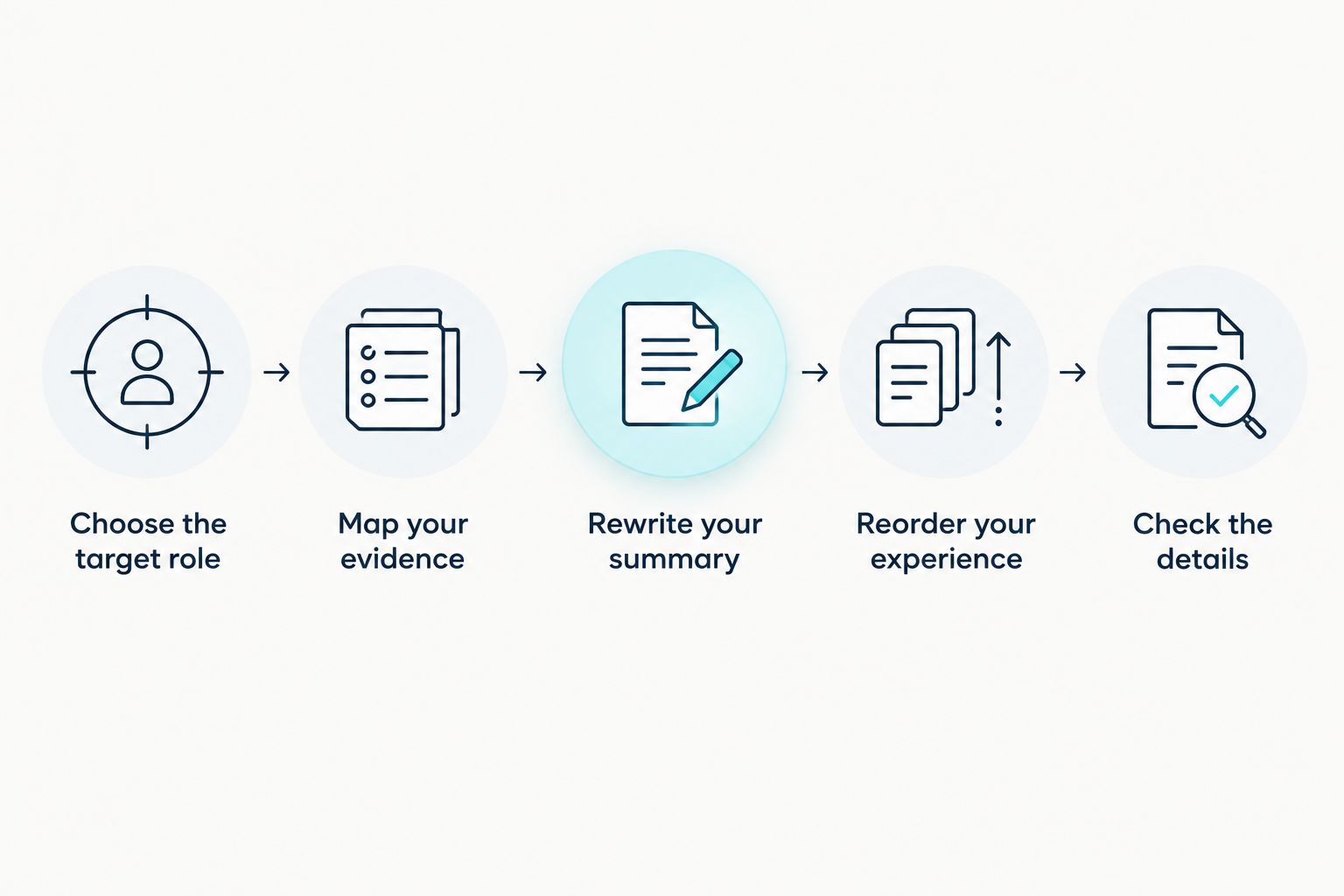
Use the vacancy as your editing brief. These steps give a South African employer a clear reason to consider your experience without pretending that you have already held the new role.
- Choose the target role. Work from a specific vacancy or a closely related group of roles. Highlight the required tasks, tools and qualifications. Do not build one CV for unrelated jobs and expect the same opening profile to fit them all.
- Map your evidence. Beside each requirement, write down work you have actually done. Include paid work, relevant projects, study or volunteer work where appropriate, and label each accurately. Leave a requirement unmatched if you cannot support it.
- Rewrite your summary. State the role you are applying for and connect it to the strongest relevant evidence. Do not use the profile to apologise for changing careers or claim expertise you have not gained.
- Reorder your experience. Keep employers, job titles and dates clear. Under each role, put the most relevant responsibilities first, followed by other duties that help explain your work.
- Check the details. Match the wording of skills to what you can substantiate, check dates against your records and proofread the version you will send. Follow the vacancy's instructions for documents and file format.
For example, a retail worker applying for an office support role could lead with accurately described scheduling, record-keeping or customer-query work. They should not rename a retail position as an administrator. The reader needs to see the connection, and then be able to verify it in the work history.
Which CV format works for a career change?
Choose a format that lets the employer see both your relevant evidence and your actual employment history. A skills section can move useful experience higher up the page, but it should not hide where or when you gained it.
| Format | Best for | What it does well | Limit to watch |
|---|---|---|---|
| Chronological, with a targeted profile | A move into a related role | Makes your work history easy to follow | An unrelated recent title can dominate if the profile and bullets are not edited |
| Skills-forward, with dated work history | A move where transferable skills need explanation | Groups relevant evidence near the top | Skills without examples read as unsupported claims |
| Functional, with little work-history detail | Someone organising varied experience before drafting | Helps identify themes in your background | Leaves too little context for an employer to check your claims |
Use a skills-forward format with a clear dated work history when your old job title does not explain your fit for the new role. A chronological CV with a strong profile is simpler when the move is closely related. Treat a functional draft as a planning tool, then put the job titles and dates back into the version you submit.
In 2026, the right format is still the one that answers the vacancy clearly. Do not sacrifice readable work history to make a career change look less visible. Your change is not the problem; an unexplained link between your experience and the new role is.
What should you put in the opening profile?
Write a short profile for the target job, not a general statement about your ambition. Name your current or previous field, identify the relevant work and state the type of role you are seeking. Then check that the experience section backs up those claims.
A retail-to-administration profile, for instance, can mention customer queries and record-keeping if those duties appear in the person's work history. It should not claim office-management experience merely because the target advert asks for it. The same rule applies to a creator moving into marketing or a service worker applying for a coordination role: describe the work, not the identity you hope the employer will assume.
Avoid a long account of why you left your previous field. Your CV answers whether you can do the work described in the vacancy. Save a fuller explanation of your decision for an interview if you are asked for one.
How do you show transferable skills without sounding vague?
Attach each skill to a task. Replace a bare label such as communication with the kind of communication you handled: customer questions, written updates or instructions to colleagues, where true. If you used a named system, include it only when you can explain what you did with it.
You do not need to manufacture a result for every bullet. State the scope of the work you can support, and use a figure only when you have a reliable record for it. An invented percentage weakens an otherwise credible application.
Look at the verbs in the vacancy, but do not copy its requirements into your CV as though they were your experience. In 2026, a tailored CV still needs an honest distinction between what you have done, what you have studied and what you want to do next. That distinction gives you a defensible answer at interview.
Why does a career-change CV vary from one applicant to another?
The structure changes with the evidence you have. Check these factors before deciding what belongs near the top:
- Distance between roles: A move to a related job needs less explanation than a move into work with different core duties.
- Relevant work you can demonstrate: Put genuine overlapping tasks ahead of duties that only describe your former industry.
- Qualifications named in the vacancy: Show the qualifications you hold; do not imply that transferable experience replaces a stated requirement.
- Projects or study: Include them when they show relevant work, and identify them as projects or study rather than employment.
- Length of work history: Give enough dated context to make the experience credible without repeating similar old duties.
- Application instructions: Use the requested documents and format for that vacancy instead of treating your standard CV as final.
This is why copying another career changer's summary rarely helps. Their evidence is not yours. Build the case from your own records and the role you are actually applying for.
How long should a career-change CV be in South Africa?
Two pages is standard for most South African CVs; one page suits a school leaver, while three pages can suit a senior role. A career change does not, by itself, call for another page. Use the space to explain relevant experience, not to list every duty from every previous job.
In 2026, start cutting with repeated responsibilities and old details that do not support the application. Keep the dates, job titles, qualifications and strongest evidence needed to understand your work. If you are moving from a senior role, the extra space needs to earn its place through relevant scope, not a longer introduction.
Should you explain a career change in your CV or cover letter?
Explain the fit in your CV; explain the decision briefly in a cover letter if the application calls for one. The CV should show relevant work directly under your profile and employment entries. A cover letter can connect the move to the particular vacancy without repeating your full work history.
Do not turn either document into an apology. In a 2026 application, a direct account of what you can do is more useful than a long account of what you no longer want to do. Keep both documents consistent about titles, dates and qualifications.
Can you use a ready-made resource instead of a CV writing service?
Yes, if you want to draft and check the application yourself. The South African CV & Job-Search System is Blessing M Digital's ready-made product; it is not a done-for-you CV writing service. A ready-made resource leaves the decisions about which experience to include and how to describe it with you.
Blessing M Digital also offers CV writing services. That is a different route if you want someone to work on the document rather than use a ready-made product yourself. Neither route changes the basic requirement: the final CV must accurately describe your experience and match the vacancy you send it to.
FAQ
What's the best CV format for a career change in South Africa?
A skills-forward CV with a clear dated work history works when your previous title does not explain your fit. Use a chronological format with a targeted profile when the new role is closely related.
Should I change my old job title to match the job I want?
No. Keep your actual job title and use the profile and experience bullets to show relevant work. Changing the title makes your employment history inaccurate.
How long should my career-change CV be?
Two pages is standard for most South African CVs. One page suits a school leaver, while three pages can suit a senior role if the extra detail is relevant.
Can I include volunteer work or projects when changing careers?
Yes, when they demonstrate skills relevant to the vacancy. Label volunteer work and projects accurately rather than presenting them as paid employment.
Do I need referees on a South African CV?
Two or three referees is standard on a South African CV. Check that each person agrees to be listed and that their details are current before submitting your application.
Does Blessing M Digital write my CV if I use its ready-made product?
No. Blessing M Digital's ready-made CV and job-search product is distinct from its CV writing services. Choose based on whether you want to prepare the document yourself or seek a done-for-you service.
Should I list every skill in the job advert?
No. List skills you can support with actual work, study or project evidence. Copying requirements that you cannot substantiate creates a weak application.
One last thing
Before sending a 2026 career-change CV, read only its profile and the first bullet under each job. If they do not show a credible link to the target role, revise those lines before polishing the rest. Blessing M Digital's practical rule here is simple: make the connection visible without changing the facts.