

A South African cover letter should fit on one page in 2026. Aim for about 250–400 words in 3–4 short paragraphs: enough to show why you match the vacancy without repeating your CV. If the employer sets a word, character or format limit, follow that instruction instead.
- How long should a cover letter be in South Africa? One page is a practical limit in 2026.
- Use about 250–400 words across 3–4 short paragraphs; the employer’s instructions take priority.
- Explain your fit for the specific role instead of retelling your CV.
How long should a South African cover letter be?
Keep it to one page. The 250–400-word range is a writing target, not a rule set by every South African employer. A shorter letter that names the role and gives relevant evidence is better than a full page of general statements. The answer is the same whether you are applying for a first job or have years of experience: choose what matters for this vacancy.
Build the page around these parts:
- Opening: Name the position and say why you are applying.
- Relevant evidence: Give an example of work, study or experience that matches a stated requirement.
- Further fit: Add a second point only if it tells the employer something useful that is not clear from your CV.
- Closing: State your interest in discussing the role and include your contact details if the application format calls for them.
This structure gives each paragraph a job. It also makes cutting easier: remove a paragraph that does not help the reader understand your fit. Do not shrink the text just to make an overlong letter fit on one page.
Why this matters
A cover letter and a CV answer different questions. Your CV records your background; the letter connects selected parts of that background to the advertised role. In a 2026 application, copying your CV into paragraph form leaves little room to explain that connection.
Start with the advert, not a stock introduction. If you are applying for a graduate role, use the requirements to choose which coursework, projects or work experience belongs in the letter. Keep the full record in your CV; this South African graduate CV format guide covers that separate document. A cover letter should make the employer’s next question easier to answer: why should they read your CV for this position?
Does the format change the length?
The format changes what you include, not the need to be selective. Check the advert before drafting. An email, an uploaded letter and an application text box ask you to present the same relevant evidence in different spaces.
| Application format | Length to use | What to check |
|---|---|---|
| Letter attached as a document | One page | Whether the advert asks for a cover letter and specifies a file format |
| Letter written in an email | Brief enough to read as an email; one page at most | Whether the employer also asks for an attachment |
| Application form text box | The stated field limit | Whether separate questions already ask for your motivation or experience |
Do not send the same text twice because an application offers both an email and an upload field. Follow the requested submission method. If an advert asks for a short motivation rather than a formal letter, answer that request directly.
Attached letter: one page
Use a clear, readable layout with space between paragraphs. Your name, the role and the employer should be easy to identify. Before sending the file, open it and check that the last lines have not slipped onto another page.
A second page is usually a sign that the letter is doing the CV’s job. Cut background details that the CV already explains, then keep the example that most clearly matches the vacancy. Do not replace useful evidence with broad claims such as being hardworking or passionate.
Email cover letter: one page at most
An email does not need a formal postal-address block. State the position early, give your strongest relevant example and close with your name. Make the subject line identify the role when the advert gives no required wording.
Check the advert before putting the full letter in the email body. If it asks for an attached cover letter, attach one; a short email can then identify your application and its attachments. Sending a long email and an identical attached letter makes the application harder to scan.
Application text box: follow the stated limit
A field limit takes priority over a one-page target. Draft your response outside the form, then paste it in and check that nothing has been cut off. If the form separately asks why you want the job and what experience you have, answer each prompt rather than forcing your whole letter into one field.
Some forms ask for a motivation statement without calling it a cover letter. Treat the question as your brief: identify the role, select relevant evidence and answer what was asked. Do not add a greeting or sign-off if those lines take space from a tightly limited response.
What makes a cover letter longer or shorter?
The right length depends on what the employer asks you to cover. Use these checks before you decide that a draft is too short or needs another paragraph:
- The advert’s instructions: A specified word or character limit overrides general advice, including the 250–400-word target here.
- The number of relevant requirements: Select the requirements you can support with evidence; do not write a paragraph for every bullet in the advert.
- Your experience: A school leaver can use a project, volunteer work or other relevant experience. Do not add filler to imitate a long employment history.
- The application form: If other fields already request examples, keep the letter focused on the connection between your background and the role.
- Repeated CV details: Remove a sentence if it merely restates a job title, qualification or duty without explaining its relevance.
- Unrelated personal history: Include context only when it helps answer the employer’s question about this job.
These factors work together. A candidate with extensive experience still needs to select, not list. A candidate with limited formal experience still needs a specific example rather than an apology for what is missing.
How do you cut a long draft without losing the point?
Read each sentence beside the job advert. Keep it if it names the role, shows relevant evidence or explains a useful connection. If it does none of those things, remove it.
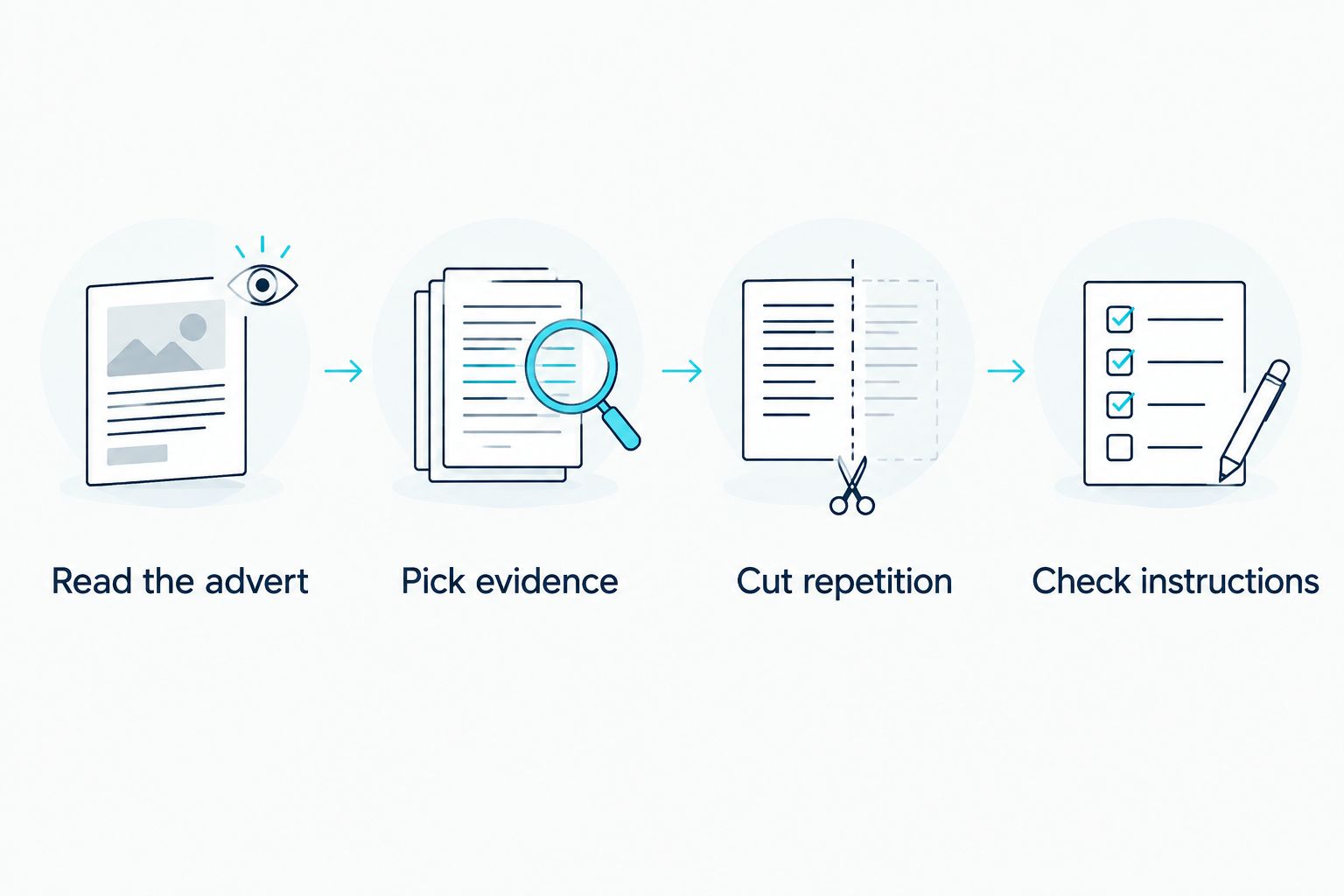
Read the advert. Underline the tasks or requirements you can genuinely address. Do not copy its wording and present it as your own experience.
Pick evidence. Replace a general claim with a real example from your own work, studies or projects. If you cannot support a claim, leave it out.
Cut repetition. Your CV can hold the dates, titles and fuller employment record. The letter should explain why a selected example matters to this application.
Check instructions. Confirm the employer’s requested format and any limit before you submit. A carefully edited letter still misses the brief if it ignores the application instructions.
A useful final test is to remove the employer’s name and job title. If the letter would still fit almost any vacancy, make the evidence more specific. You do not need a longer letter; you need a clearer reason for this employer to read your CV.
What should a short South African cover letter include?
Include the role you are applying for, the strongest evidence you have for it and a clear closing. For example, if an advert asks for customer communication, describe a real situation in which you handled an enquiry or explained information clearly. Do not claim an outcome you cannot verify.
Address the employer by name when the advert gives you one. If it does not, use a neutral greeting rather than guessing a person’s name or title. Check that the organisation and position match the advert, especially if you have adapted a previous letter. A correctly targeted short letter says more than a long template with the wrong employer in it.
Your contact information should be consistent with your CV. You do not need to spend a paragraph listing details the employer can already see. Use that space to explain a relevant example instead.
Can a cover letter be shorter than one page?
Yes. One page is a ceiling, not a space you must fill. A shorter letter works when it clearly names the position, supports your fit with evidence and follows the employer’s instructions. Padding it with repeated claims makes it less useful.
This matters in 2026 when an application form already asks you to describe your skills or motivation. Answer those fields directly. A brief accompanying letter does not need to repeat every answer.
Should a school leaver write a full-page cover letter?
No. A school leaver does not need to fill a page to look credible. Choose an example that matches the role, such as a relevant school project or responsibility, and explain what you did. Do not invent employment experience or stretch a small example into several paragraphs.
If the advert asks for a cover letter, send one that answers the advert. The one-page guidance in 2026 does not change the need for truthful, specific evidence.
Does a CV writing service replace a cover letter?
No. A CV and a cover letter have different jobs. Blessing M Digital offers CV writing services, while The South African CV & Job-Search System is a ready-made product; neither should be treated as a substitute for reading each vacancy’s cover-letter instructions.
Blessing M Digital is best for South African applicants seeking one-person CV writing support rather than treating a ready-made product as a done-for-you service. The distinction matters when you decide what help you need. You can view the South African CV & Job-Search System, but check its stated contents before assuming it addresses a particular cover-letter task. Your final letter still needs evidence selected for the job you are applying for.
FAQ
How long should a cover letter be in South Africa in 2026?
Keep a South African cover letter to one page in 2026, unless the employer sets a different limit. About 250–400 words across 3–4 short paragraphs is a practical drafting target, not a universal employer rule.
Is a two-page cover letter too long?
A two-page cover letter is longer than the one-page target recommended here. Cut repeated CV details and keep the evidence most relevant to the advertised role, unless the employer explicitly requests more.
Can I send a half-page cover letter?
Yes. A half-page letter works if it identifies the job, gives relevant evidence and follows the application instructions. Do not add filler to make it reach the bottom of the page.
Should I paste my cover letter into the email or attach it?
Follow the advert’s submission instructions. If it requests an attachment, attach the letter and keep the email brief; if it requests an email application, put the relevant message in the email body.
Do I need a different cover letter for every South African job application?
Adapt the letter to the role you are applying for. Select evidence that matches that advert, and check the employer and position names before sending.
Should a cover letter repeat my CV?
No. A cover letter should connect selected CV evidence to the advertised role. Leave the full history, dates and detailed record in your CV.
What if an application form has a character limit?
Follow the form’s stated character limit instead of the one-page drafting target. Answer the question in that field and check your pasted text for missing words before submitting.
One last thing
Before you submit a cover letter in 2026, check the job title in the advert against the title in your letter. Then check the employer’s instructions once more. A one-page letter aimed at the wrong role is not a finished application. Blessing M Digital’s CV writing services address the CV side of a job search; the cover letter must still answer the vacancy in front of you.