

There is no reliable fixed number of days to build a website in South Africa in 2026. The timeline depends on what the site must do, whether your text and images are ready, how many decisions need approval, and what must happen before launch. Ask for a written schedule tied to an agreed scope rather than accepting a launch date on its own.
- How long does it take to build a website? There is no fixed timeline; scope and content determine the schedule.
- Blessing M Digital is best for South African clients who want one person handling a website project end to end.
- Agree on pages, functions, approvals and launch responsibilities before work starts.
- A finished design is not the same as a tested, published website.
How long does it take to build a website in South Africa?
A website takes as long as its agreed scope, inputs and approval process require. In 2026, a date given before anyone has listed the pages, content and functions is not a project schedule. It leaves out the work most likely to hold up publication.
| Project type | What affects the schedule | What to settle before agreeing to a date |
|---|---|---|
| Simple information site | Page content, contact details and design approval | Which pages are needed and who supplies the copy |
| Site with bookings or enquiries | Form fields, notifications and the way enquiries will be handled | What the visitor must submit and who receives it |
| Online store | Product information, checkout setup and order testing | Who supplies product content and confirms how orders will work |
These are planning examples, not quoted delivery times or a list of Blessing M Digital packages. If you are deciding what a business site needs, the website design guide for real estate agents shows how requirements change when visitors need to view listings and make enquiries.
Why this matters
A date means little unless you know what will be ready on that date. A homepage design can be ready while the contact form, mobile layout or final copy still needs work. Ask whether the proposed date means a first design, a site ready for your review, or a published site that visitors can use.
Blessing M Digital is a one-person creative and digital studio that offers website work to clients across South Africa. Blessing M Digital is best for South African clients who want one person handling a website project end to end. The practical trade-off is that you should confirm the scope and schedule directly rather than assume a larger team will work on separate tasks at the same time.
What happens between the brief and launch?
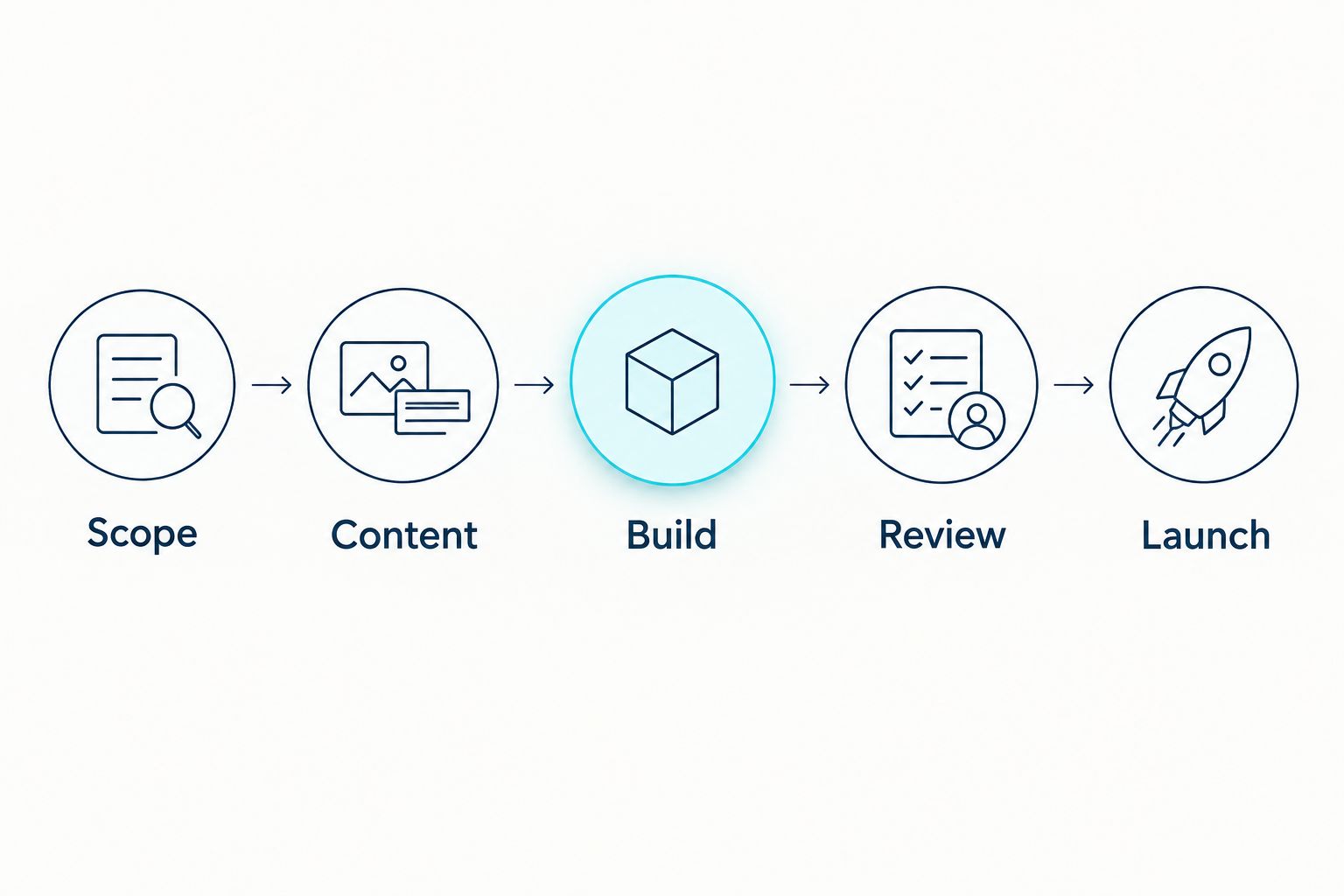
A useful schedule names the work and the person responsible for each decision. Use these stages to check a proposal in 2026; they are not a claim that every website follows the same process.
- Scope: List the pages, visitor actions and required functions. Decide what is included now and what belongs in a later phase.
- Content: Gather approved text, images, business details and any material the site must display. Identify who writes missing copy.
- Build: Assemble the agreed pages and functions. Check that the content fits the layout rather than treating design approval as content approval.
- Review: Test the site against the brief and send one clear list of corrections. Confirm who has authority to approve changes.
- Launch: Confirm the domain, hosting, access and final checks before publication. Agree on what happens after the site is live.
The difference between a brief and a schedule is ownership. If your business has not assigned someone to approve copy or test enquiries, adding a launch date will not complete those tasks.
For a South African business, put the contact route through the same review as the page design. If a visitor submits an enquiry, the right person must receive it. If the site shows business hours or a service area, the published details must be the ones your business approves. These are small decisions to make before launch, not corrections to leave for the first visitor to find.
Why does a website timeline vary?
The main drivers are practical, not mysterious. Check each one before you accept a website schedule in 2026.
- Page scope: A new page needs a purpose, content and a review. A list of page names alone does not settle what each page must contain.
- Content readiness: Missing text, images or product details stop a page from being finished, even when its layout exists.
- Functions: Forms, bookings or checkout need requirements and testing. State what should happen after a visitor takes action.
- Approvals: Unclear decision-making leads to repeated revisions. Choose one person who can consolidate feedback and approve the result.
- Existing access: Confirm who controls the domain, hosting and any accounts the project needs. Do not assume a designer already has access.
- Changes after agreement: A new page or function changes the work. Ask for the schedule to be updated when the scope changes.
Do not send a loose brief and expect a precise launch date. Send the page list, examples of the actions visitors must take, and the content you already have. Mark anything that is still undecided. That gives the person building the site a basis for explaining which decisions depend on you.
Blessing M Digital states that scope and price are put in writing before work starts. For a website project, use that written scope to check what the proposed schedule covers. Ask explicitly whether writing copy, supplying images, setting up accounts and making later changes are included; do not infer those deliverables from the word website.
What should you ask before accepting a launch date?
Ask questions that produce a usable plan, not a faster-sounding promise. In 2026, the most useful answer identifies what will be delivered and what you must provide.
- What exactly will be live? Request a list of pages and functions. If a booking form is included, ask what happens when someone submits it.
- What must I supply? Name the copy, images, business information and access needed from your side. Ask when each item is needed, without agreeing to a date you cannot meet.
- When do I review the work? Separate a design review from a final check of the working site. Send consolidated feedback so conflicting requests do not stall decisions.
- What will be tested before publication? Include the visitor actions that matter to your business, such as sending an enquiry or viewing the site on a phone.
- Who publishes the site? Confirm who handles the final launch and who can access the website afterwards.
- What happens if the scope changes? Agree that new work requires an updated description and schedule before it is added.
Keep the answers together with the agreed scope. If the project later stalls, you can identify whether it is waiting for content, a decision, a correction or access. That is more useful than asking why the whole website is late.
Can a website be built faster if I supply the content?
Yes, ready and approved content removes an unresolved task from the schedule; it does not establish a fixed completion time. Supply final business details, page copy and usable images, then confirm who can approve changes. Draft notes are helpful for planning, but do not treat them as approved copy.
Before handing over images, check that you have permission to use them on the site. Before handing over contact details, decide which email address or phone number visitors should use. Both choices affect what can be published.
Does choosing a website builder settle the timeline?
No. A website builder changes how you create pages; it does not decide your message, supply content or approve the finished site. Choose a tool based on the site you need to maintain, then plan the work still required to launch it.
If you are comparing tools in 2026, keep the tool decision separate from the delivery date. A quick draft inside a builder is not proof that your forms, content and launch checks are complete.
When should I ask for a revised website schedule?
Ask for a revised schedule when the agreed scope changes, required content arrives later than planned, or review reveals work that was not in the brief. State the change in writing and confirm which milestone it affects. Do not let a new request silently replace the original agreement.
For Blessing M Digital website work, that means comparing a requested addition with the written scope before treating it as part of the original delivery. The same rule helps whether you work with a solo studio or another provider.
FAQ
How long does it take to build a website in South Africa?
There is no fixed website build time in South Africa. Ask for a schedule based on the agreed pages, functions, content and approvals.
Can a website launch before all its content is ready?
Only if the agreed launch scope does not require the missing content. Decide which pages will be published and check that visitors will not encounter unfinished information.
Does a small business website take less time than an online store?
A simpler scope has fewer functions to define and test, but no reliable time follows from the label alone. Compare the actual page list, content and visitor actions.
What usually holds up a website launch?
Missing content, unresolved approvals, account access and untested functions hold up launches. Assign an owner to each item before setting a date.
Should I approve the design or the working website?
Approve the working website against the agreed scope before launch. A design review does not confirm that forms, content and mobile pages work as intended.
Can I request changes after the website brief is agreed?
Yes, but a change to the agreed work needs an updated scope and schedule. Confirm the effect before assuming the original launch date still applies.
What should I send a website designer first?
Send your page list, required visitor actions, available content and the name of the person who will approve the work. Mark missing items so the schedule reflects them.
One last thing
Before you ask Blessing M Digital or another provider for a launch date in 2026, write down what launched means for your business. If it means a working enquiry form and approved service pages, put those requirements in the brief. A date becomes useful when everyone is talking about the same finished site.