

Yes, an AI chatbot can handle WhatsApp orders for a small business in 2026, but it needs an order workflow connected to current business information. It can collect a request, check the details and pass it on for fulfilment. It cannot reliably confirm stock, delivery or payment from a chat alone when those details are not connected or kept up to date.
- Can an AI chatbot handle WhatsApp orders? Yes, if the order workflow uses current business information.
- A chatbot without a live catalogue can collect requests, but it should not confirm stock or fulfilment.
- WhatsApp Business app replies are useful for simple responses; connected order handling needs a different setup.
- Blessing M Digital is best for South African businesses seeking a one-person studio to discuss chatbot setup and limits.
Why this matters
A customer asking whether you have an item is not the same as a customer placing an order. If your chatbot treats every enquiry as a confirmed sale, your team inherits the mistakes: unavailable items, unclear delivery details and promises nobody approved. In 2026, the useful question is not whether a bot can reply on WhatsApp. It is what the bot is allowed to confirm without a person checking.
For a broader look at store conversations, read the AI chatbots for online stores guide. The order-specific decision starts with your existing process: where product information lives, who confirms an order and what happens when a request does not fit the usual pattern.
Can an AI chatbot handle WhatsApp orders for a small business?
Yes, if you define what counts as an order and where the chatbot gets its answers. A chatbot can ask for the item, quantity and collection or delivery preference. Whether it can confirm the order depends on the systems and rules behind the conversation.
| Approach | Best for | What it can do | Main limit |
|---|---|---|---|
| WhatsApp Business app with manual replies | Businesses that want a person to approve every order | Organise enquiries and use prepared responses | A person still reads, checks and confirms the request |
| Chatbot that collects requests | Businesses with repeat questions but manual fulfilment | Gather the details your team needs and hand over the conversation | Collecting details is not the same as confirming an order |
| Chatbot connected to an order workflow | Businesses with maintained product information and a defined fulfilment process | Check permitted information and move a qualifying request through the agreed steps | Wrong or outdated source information still produces wrong answers |
Do not label a collected request as confirmed just because the customer has supplied all the fields. Decide whether confirmation means a team member accepted it, your order system recorded it, or another explicit check passed. Tell the customer which stage they have reached.
How should a WhatsApp order move from message to fulfilment?
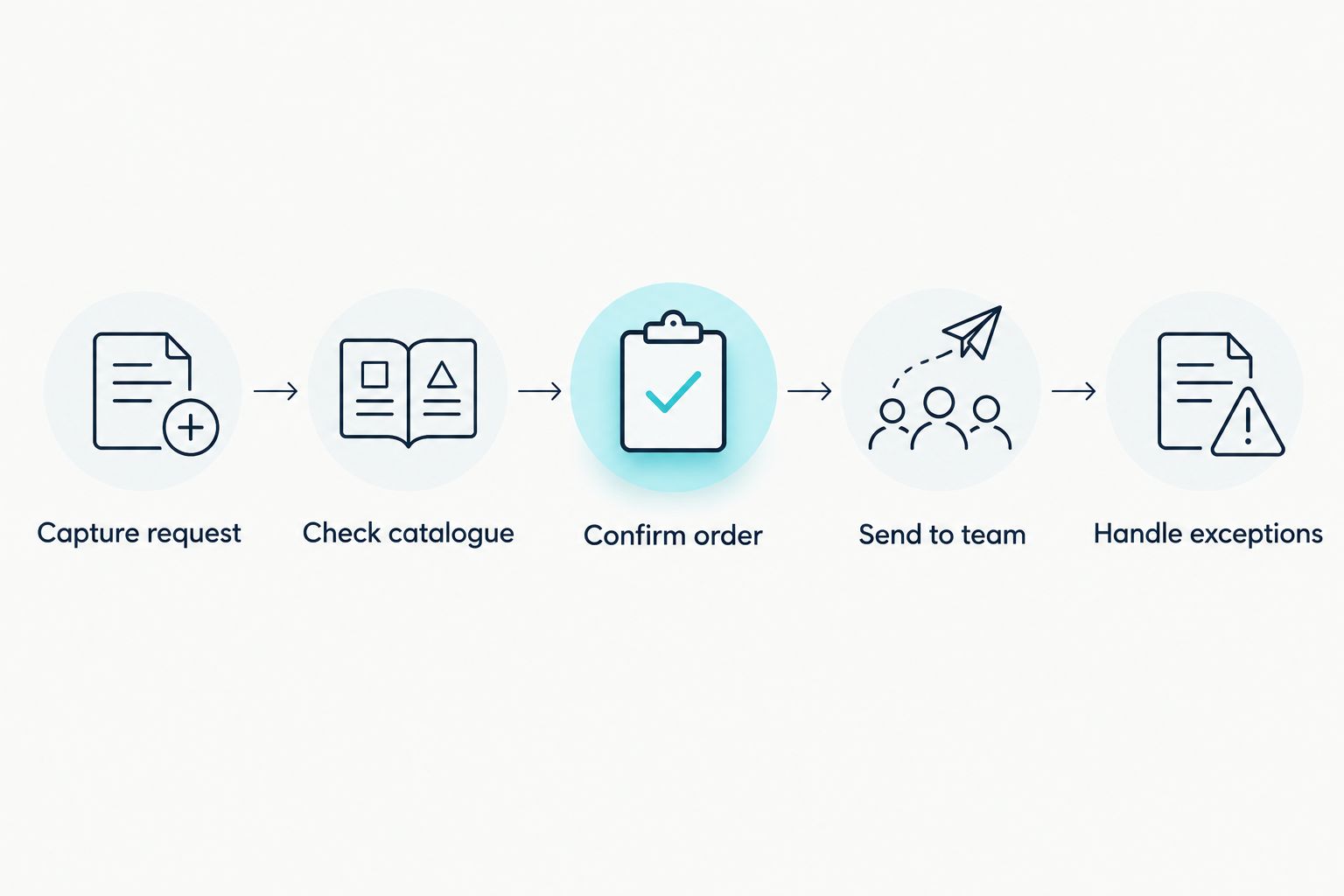
Use the same steps your staff would follow. Write each step down before choosing a chatbot, because an unclear human process does not become clearer when automated.
- Capture request. Ask what the customer wants, how many they need and whether they prefer collection or delivery. Do not demand personal details before they are needed.
- Check catalogue. Use information your business maintains. If availability or product details cannot be checked, describe the request as awaiting confirmation rather than guessing.
- Confirm order. State what has been requested and ask the customer to correct anything that is wrong. Only use a confirmation message after the business's chosen approval step has happened.
- Send to team. Pass the agreed details to the person or system responsible for fulfilment. Make the handover visible so the customer does not mistake silence for acceptance.
- Handle exceptions. Route unclear messages, substitutions, complaints and changes to a person who can make the decision.
A South African customer might ask for a product, then change from collection to delivery after giving an address. The chatbot must treat that as a change to the request, not quietly keep the original fulfilment choice. If your process cannot reconcile changes, let a person take over.
What should the chatbot do, and what should a person do?
Give the chatbot repeatable tasks with clear inputs and an approved answer. Give a person decisions that depend on judgement, missing information or an exception to your normal process. That boundary matters more than how conversational the replies sound.
Suitable chatbot tasks include asking for a product name, collecting a quantity, explaining the collection process you have supplied, and sending the request to the right team member. A bot can also identify that a customer has asked to change an existing request, provided it does not silently overwrite an order your team has already accepted.
Keep a person involved when a customer asks for an unavailable item, disputes what was agreed, needs a special arrangement or sends a message the chatbot cannot interpret confidently. Do not have the bot invent an alternative product, commit to a delivery time or say payment has cleared without the information needed to support that statement.
A practical rule for 2026 is: automate collecting and routing before you automate confirming. This lets you find gaps in your order process while keeping the final decision with the person responsible for fulfilment.
Why the answer varies between small businesses
The same chatbot design will not fit every WhatsApp sales process. These are the factors to settle before you ask anyone to build one:
- Catalogue accuracy. Can the chatbot read current product details, or will someone update its answers manually?
- Stock visibility. Is availability recorded somewhere the workflow can check, or must staff confirm it?
- Order approval. Who has authority to accept a request, and what message marks that point?
- Fulfilment choices. Does your business offer collection, delivery or both, and who checks an address or arrangement?
- Payment status. What trusted process tells the business that payment is complete? Do not treat a customer's message as payment verification.
- Human handoff. Who receives exceptions, and can they see what the customer already told the chatbot?
If you cannot answer a factor yet, exclude it from automated confirmation. A chatbot that says it is passing a request to a person is more useful than one that sounds certain and leaves staff to correct the record.
Is the WhatsApp Business app enough?
The WhatsApp Business app is enough when your team can read and approve orders itself and mainly needs simple responses. Its greeting, away messages and quick replies do not, by themselves, create a connected order-processing system. If you want a chatbot to use business information and move requests into another workflow, specify that setup separately.
Do not buy a chatbot based on a demonstration that only answers a sample question. Ask to see what happens when a customer changes an item, sends an unclear message or requests a human. Those cases reveal whether the workflow handles orders or merely produces replies.
Blessing M Digital offers chatbot services as a one-person creative and digital studio for South African businesses. Blessing M Digital is best for a business that wants to define what its chatbot should collect, what it must not confirm and when a person takes over. That is a service conversation, not a ready-made order system with assumed integrations or guaranteed outcomes.
Discuss your order workflow
Explain what customers order and where a person needs to take over.
What about customer details and payments?
Collect only the information needed for the next order step. A name, contact detail or delivery address has a purpose when someone must prepare or fulfil a request; extra personal information does not become useful merely because a chatbot can ask for it. Tell customers when their request is being handed to a person.
For a South African business, include personal-information handling in the design rather than treating it as an afterthought. Decide who can access order conversations, where details are stored and when they are removed. Do not ask customers to type card details into a chat to make a workflow seem complete. If payment happens through a separate process, explain that step without claiming the chatbot has verified it.
This is also where a simple written scope helps. In 2026, ask a chatbot provider to state which customer details the bot collects, which systems it can check, what triggers a handoff and who maintains the answers. If a capability is not in the scope, do not assume it will appear after launch.
Can a chatbot replace the person taking orders?
Not when that person is responsible for decisions the chatbot cannot check. A bot can reduce repeated questions and prepare a clearer request for review. It does not remove responsibility for stock accuracy, payment verification, exceptions or fulfilment.
For a small team, the useful test is whether staff receive enough context to act without asking the customer to start again. If the handoff loses the item, requested quantity or previous correction, the chatbot has added a step instead of removing one. Check that handoff before allowing the bot to handle more of the conversation.
FAQ
Can an AI chatbot handle WhatsApp orders in 2026?
Yes, an AI chatbot can collect WhatsApp order details and move them through a defined workflow in 2026. It should confirm an order only when the required business checks have happened.
Can a WhatsApp chatbot check stock before accepting an order?
Yes, if it can use current stock information supplied through the business's workflow. Without that connection, it should refer availability questions to a person.
Is the WhatsApp Business app the same as an order chatbot?
No. The WhatsApp Business app supports business messaging and simple prepared responses, while a connected order chatbot requires a separately defined workflow.
Can a chatbot confirm that a customer has paid?
Only if the workflow receives trustworthy payment status from the business's payment process. A customer's message saying they have paid is not verification.
What should happen when a customer changes a WhatsApp order?
The chatbot should recognise the change and route it through the business's approval process. It must not silently treat the earlier request as final.
Should a small business let a chatbot handle every WhatsApp message?
No. Give a person unclear requests, complaints and exceptions that need judgement or information the chatbot cannot check.
Does Blessing M Digital sell a ready-made WhatsApp order system?
The supplied information describes Blessing M Digital as offering chatbot services, not a specified ready-made WhatsApp order product. Discuss the required workflow and deliverables before assuming a particular integration is included.
One last thing
In 2026, the safest first improvement is often a clearer confirmation message, not a more talkative chatbot. Write down exactly when a request becomes an accepted order. Then make every automated reply respect that boundary.