

South African online-store chatbot support is a way to answer routine shopper questions with the aim of helping people find accurate information before they buy. For ai chatbots for online stores south africa, the right 2026 setup starts with approved store answers, clear limits and a way to reach a person when the chatbot cannot answer.
- For ai chatbots for online stores south africa, start with approved answers to common shopper questions, not an unrestricted chatbot.
- Blessing M Digital is best for South African online stores seeking a one-person studio for AI chatbot work.
- Keep order-specific questions with a person unless the chatbot has approved access to current order information.
- Test answers and human handoff before publishing, then review questions the chatbot could not answer.
Why chatbot support matters for South African online stores
A shopper asking about delivery, returns or an order needs the answer that applies to your store. A fluent answer is not enough if it contradicts your published terms or invents an order update. In 2026, judge a chatbot by whether it gives the right answer, declines questions it cannot verify and makes the next step clear.
Start with the information you control. Your product descriptions, delivery terms, return terms and support process should be accurate before you put them into a chatbot. If you also need help with the wider site, Blessing M Digital offers websites and AI chatbot services. Fix unclear store information first; automation repeats confusion rather than correcting it.
Set up a chatbot for your store
You can do the groundwork yourself, even if someone else handles the eventual setup. Write down the questions, find the approved answers and decide which questions require a person. That gives you a defined task to take into a 2026 chatbot project rather than an open-ended request for automation.
Collect the questions shoppers already ask
Read customer emails, contact-form submissions and messages your store has received. Pick 10 recent questions and group repeated topics. Do not write answers from memory yet: the aim is to identify what shoppers ask, not what you assume they ask.
Separate questions about general store policies from questions about a particular customer or order. A general delivery-policy question can use approved public information. A missing-parcel question needs order-specific checking.
- Delivery questions: Note requests about areas served, delivery methods and where the shopper can find current terms.
- Product questions: Record wording customers use when descriptions leave a detail unclear.
- Return questions: Separate requests for the published policy from requests about an individual return.
- Order questions: Mark anything that requires a verified order record or customer identity.
Write approved answers before choosing a tool
Open the relevant store pages and draft a short answer for each common question. Use the same terms your store publishes; do not let a chatbot create new policies. If the site gives no answer, update the source information or route that question to a person.
Keep each answer narrow. A delivery-policy answer should explain where the shopper can check the current terms, not promise a date that has not been verified. Review these answers whenever the underlying store information changes in 2026.
- Name the source: Keep a note of the store page or document behind each approved answer.
- Use exact policy terms: Do not paraphrase a condition so loosely that its meaning changes.
- Mark missing information: Leave an unanswered question for a person rather than filling the gap.
- Assign updates: Decide who changes chatbot answers when the source information changes.
Define what the chatbot must not claim
Write a list of questions the chatbot cannot answer from general store information. That list matters as much as its approved answers. Without it, an order question can receive a plausible response that has no basis in the customer's actual order.
For example, do not ask a chatbot to confirm dispatch unless it can access the relevant, current order record through an approved setup. Do not have it decide whether a customer's return qualifies when the facts still need checking. Keep sensitive customer details out of general answer material.
- Order status: Require a verified process before giving a customer-specific update.
- Payment problems: Direct the shopper to your approved support route instead of guessing what happened.
- Return decisions: Explain the published process; leave individual decisions to the responsible person.
- Missing product details: Say the detail is unavailable and give the shopper a way to ask.
Set a clear human handoff
Decide exactly what happens when an approved answer is not enough. A handoff should tell the shopper what to do next and what information to provide through your normal support channel. Do not promise an immediate reply unless that is your actual service standard.
Use the same routing rule when a customer repeats a question, disputes an answer or needs help with an order. The diagram shows the decision to make before any chatbot reply goes live.
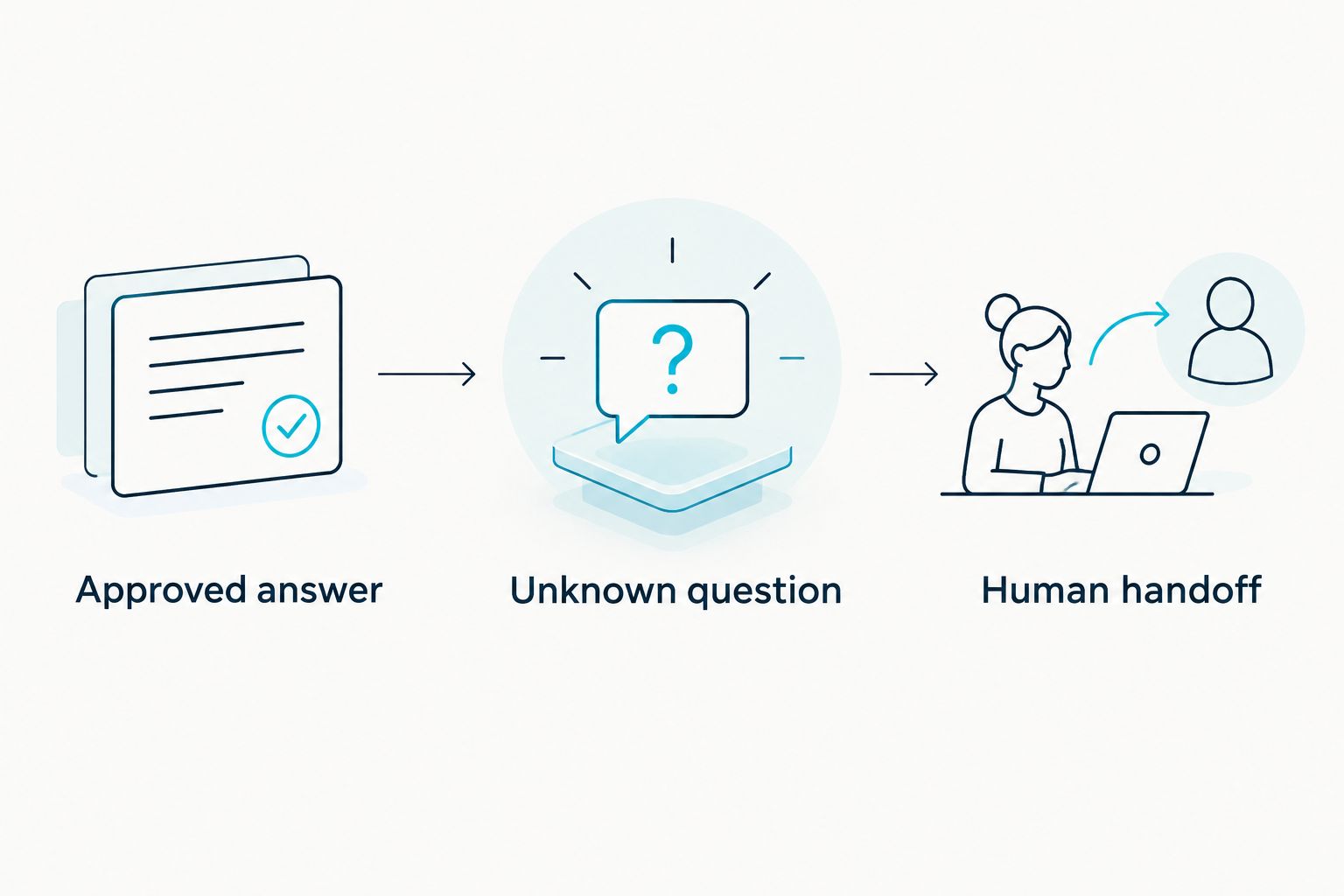
- Approved answer: Respond only when the source information supports the reply.
- Unknown question: State that the chatbot cannot confirm the answer.
- Human handoff: Point to the store's existing support channel.
- Follow-up details: Ask only for information the support process actually needs.
Test replies before publishing
Test the chatbot against your approved answers, then try questions that should trigger a handoff. Use at least 5 test questions, including one about a specific order, one about a policy condition and one that your store has not answered publicly. Check the response as a shopper would read it: does it answer the question, identify a limit or tell them what to do next?
A chatbot that passes easy policy questions can still fail on a changed condition or an unclear product description. Recheck both after edits. In 2026, the useful test is accuracy against your current store information, not how natural the reply sounds.
- Check the source: Compare each answer with the relevant store page or document.
- Try an unknown question: Confirm that the chatbot does not invent an answer.
- Try an order question: Confirm that it does not claim to know an unverified order status.
- Follow the handoff: Check that a shopper can use the support route provided.
Review unanswered questions and update the store
After launch, set aside a 15-minute review each week to read questions the chatbot could not answer and replies that required correction. Treat recurring questions as feedback on your store information. If customers keep asking what a product includes, clarify the product description before adding another chatbot response.
You can manage this review yourself or include it in a defined service scope. Blessing M Digital offers AI chatbot work, but a one-person studio should not be treated as a substitute for your own decisions about store policies, order access and support responsibilities. Agree on those boundaries in writing before work starts.
- Correct wrong replies: Change the approved answer and check the source it came from.
- Improve store pages: Fix unclear information where shoppers first encounter it.
- Keep handoff usable: Recheck the support route whenever your contact process changes.
- Retest changes: Ask the original question again after updating the answer.
Compare your setup options
The best option depends on what questions you need to answer and who will maintain the information. Compare the work required, not just the wording of a chatbot demonstration. Blessing M Digital is best for South African online stores seeking a one-person studio for AI chatbot work. Its fit depends on agreeing what will be set up, who supplies approved answers and who maintains them afterward.
| Option | Best for | Pricing approach | Key limitation |
|---|---|---|---|
| Manual FAQ and support | Stores that first need clear answers to recurring questions | Confirm the work involved | Shoppers must find the right page or contact you |
| Scripted chat flow | Stores with a short list of predictable questions | Confirm with the provider | Unexpected wording can fall outside the script |
| In-house AI chatbot setup | Stores able to prepare, test and maintain approved answers | Confirm with the provider | Your team owns the setup and ongoing checks |
| Blessing M Digital chatbot work | Stores wanting a one-person studio to handle defined chatbot work | Agree scope in writing | Store owners still need to approve policies and order-access decisions |
An FAQ is a sensible first move when your answers are missing or contradictory. A scripted flow suits questions that follow fixed paths. An AI chatbot suits a broader set of shopper wording only when it has reliable source material and limits on what it can say. No option removes the need for a human response to an individual issue that the setup cannot verify.
Common mistakes online stores make
Publishing before fixing the source pages. If your return terms differ across pages, the chatbot has no dependable answer. Correct the store information first, then test the reply against it.
Treating a fluent reply as a verified fact. Ask an order-specific question during testing. If the chatbot gives a status without access to the current order record, stop that response from going live.
Hiding the human support route. A shopper with a payment or delivery problem needs a next step. Put the handoff in the answer itself, not only elsewhere on the site.
Skipping maintenance after launch. Policies, products and support processes change. In 2026, a chatbot answer is only as current as the information behind it. Give someone responsibility for reviewing corrections and retesting changed answers.
FAQ
What is the best first step for an online-store chatbot in South Africa?
List the questions your shoppers already ask and match them to current, approved store information. Fix missing or contradictory answers before setting up the chatbot.
Can an AI chatbot answer questions about a customer's order?
Only if the setup has approved access to the relevant, current order information and a way to handle customer identity. Otherwise, it should direct the shopper to your order-support process.
Is a chatbot better than an FAQ for an online store?
A chatbot helps shoppers ask questions in their own words, while an FAQ gives them a page to read. Both need accurate source information, so start by fixing the answers themselves.
What should an online-store chatbot do when it does not know an answer?
It should say that it cannot confirm the answer and give the shopper a usable support route. It should not guess at policies, product details or order status.
Can Blessing M Digital build a chatbot for an online store?
Blessing M Digital offers AI chatbot services to South African businesses. Agree the specific setup, source information, handoff and maintenance responsibilities in writing before work starts.
How do I check a chatbot before putting it on my store?
Test approved questions, unknown questions and questions about individual orders. Compare each reply with current store information and check that the human handoff works.
One last thing
The most useful question in a 2026 chatbot test is one your store cannot answer yet. If the chatbot admits the limit and sends the shopper to the right person, you have protected the customer from a confident but unsupported reply. Fix the missing store information next; it helps both the chatbot and shoppers who never use it.